


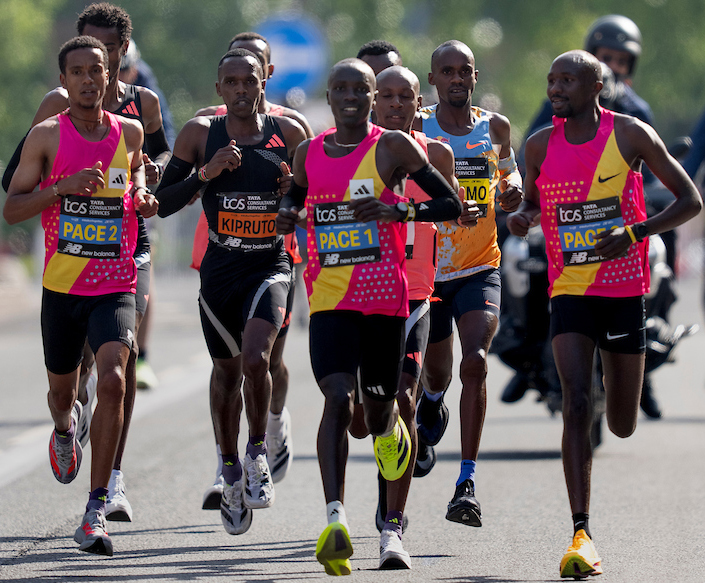
Sabastian Sawe’s training partners Amos and Benson Kipruto discuss the work ethic that led to something exceptional.
Tucked away in the high hills of Kapsabet is where you can find 2 Running Clubs. Located in Kenya’s Rift Valley, a region synonymous with producing the world’s best distance runners, it is home to a group of athletes who strive for excellence. Founded a decade ago by Italian coach Claudio Berardelli, the club is a place where its members train, recover and live together.
Life is simple. Early morning starts are common, with a strong emphasis on teamwork, the connection between the athletes and the community of the surrounding area.
Kapsabet, the capital of Nandi District, is located at an altitude of approximately 2,000 m/6,560 ft. A six-hour drive northwest of Nairobi, the environment is largely tranquil. The city is surrounded by trails and trees, where elite, novice and amateur runners share the same roads and hills.
Sebastian Sauw knows this well. He grew up about an hour away from Kapsabeth in a village called Barsombe in the Rift Valley, and it was here that the 31-year-old set a world record of 1:59:30 that made headlines.
He’s been running 2 Running Club since 2020, and according to two of his training partners, the run wasn’t a complete surprise. Amos and Benson Kipruto know Soye well. World-class athletes in their own right, the pair have won several marathon events and, with times of 2:01:39 and 2:02:16 respectively, currently sit sixth and ninth on the all-time list.
The trio are part of a wider training group that also includes Olympic 800m champion Emmanuel Vanyon, Under-20 world 1500m record holder Phanuel Kipkosgei Koch and Berlin runner-up Cybrian Cotut, among others. But regardless of accolades, everyone is treated equally, and the power of camaraderie cannot be underestimated.
“The success we’ve had is largely due to the community we have at camp,” says Benson. “We have a philosophy centered around discipline, commitment and trust in each other. It’s good for us to run here, but we all have different perspectives. Running is normal in Nandi County. But for someone who comes to camp from the outside, you can have a different perspective and you go. “Wow, people are running everywhere.”

Days usually start at 5am. Depending on the type of run, the group will usually hit the trails between 6-7am before returning for a quick shower and breakfast.
“We’ll have Kenyan tea, bananas, bread and eggs,” Benson adds. “And then maybe a mango or an orange. For lunch, which is usually between 12-1pm, we usually eat a mixture of rice, beans and potatoes. The rest of the day will depend on what you have planned individually. You can do a second run in the afternoon or evening. It also depends on what time of the season you are.
“At about 5:00 p.m., everyone has another cup of tea and then we have dinner at 7:30 p.m. We eat ugali (thick porridge made from white maize meal cooked in water or milk), managu (a traditional African vegetable rich in iron) and a variety of meats.”
The famous delicacy, however, is mursik, a fermented drink made from cow’s or goat’s milk, which is a cultural cornerstone for the Kalenjin community, who live mainly in the southern Rift Valley.
While Benson watched Sawe’s two-hour marathon from Kapsabet; the four-time major marathon champion finished third in Boston a week ago in 2:02:50, Amos was right in London finishing fourth in 2:01:39 behind Sawe, Yomif Kejelcha (1:59:04) (1:59:00). equaled the late Kelvin Kiptum’s world record of 2:00:35.
While he believed Soi would break the two-hour barrier in his career, Amos didn’t think it would happen this year in London. After we went into halftime with the lead at 60:29, that mindset changed.

“After seeing the time on the leading car, I thought: “Wow, we’re running fast!” When I spoke to Sebastian after the finish line and he said: “1:59:30”, I was happy because this is someone I train with and know well. It’s a great moment for our group.
“For an individual to break a world record, you have to have strong teamwork behind the scenes. If you have good morals, you have peace of mind. It gives you the best chance to win when it comes to competing.
“If you look at our group, not only Sabastyan and me, for example, we have strong guys. We do not depend on one person during training. We have a routine where we all take turns doing a long run as a group. That discipline comes from our culture, so a lot of respect goes to our coach.”
Both Amos and Benson were among the club’s earliest members and, a decade after they first joined, believed the best was yet to come, with Soye leading the way.
“I love how laid-back Sebastian is,” Benson says. “In training he can go in front or stay behind and he’s a pretty good person, the way he approaches training is incredible.
“There was one session I remember in particular where we were like, ‘This guy is amazing.’” When we were preparing for our respective marathons, we would run 25km blocks in 5km segments.
“In each of those sections, you’re going to have a slightly different variation, so you’re going up and down every time. We couldn’t keep up with Sebastian during those swings. We just couldn’t contain him.”
Amos agrees that Soye leads with her actions and notes that her personality helps inspire the wider group.
“He motivates you with his results,” says Amos AW:. “You think? “I have to cooperate in this training” because he showed that anything is possible. He ran negative splits in his preparation, so sub two hours was always going to happen at some point. I always tell myself that the body will achieve what the mind tells it to. If the mind tells you the speed is too fast, you will slow down. It looks like a negotiation, and Sebastian has such a strong mind.”
Amos and Benson made their marathon debuts in 2016 with 2:08:12 in Rome and 2:13:24 in Athens, and have witnessed the evolution of distance running over the past 10 years. There is now an undeniable belief that the world record will fall again, whether it’s Sau who achieves the feat once again or a growing group of brilliant marathon runners at the sport’s elite end.
“The breaking mark (2:00:35) had to be broken, and this will be,” says Amos. “I’ve been consistent in my career, but the running has evolved so much that I still feel like I have to be patient to get better times. I see the generation that comes after us and I think the world record will fall again. With Sebastian, we are there to cheer him on, push him and support him in every way possible.”
So how many hours is possible before the end of the decade? The answer is unanimous. 1:57
“It’s coming, you’ll see,” Benson adds. “Now there is no limit and it is no longer impossible. Shoe technology and food evolution help. So we
see marathons over two hours in the future, if not soon, then later. This is just the beginning.”
This article also appears in a special edition of Sub Two AW magazine, out now!

