


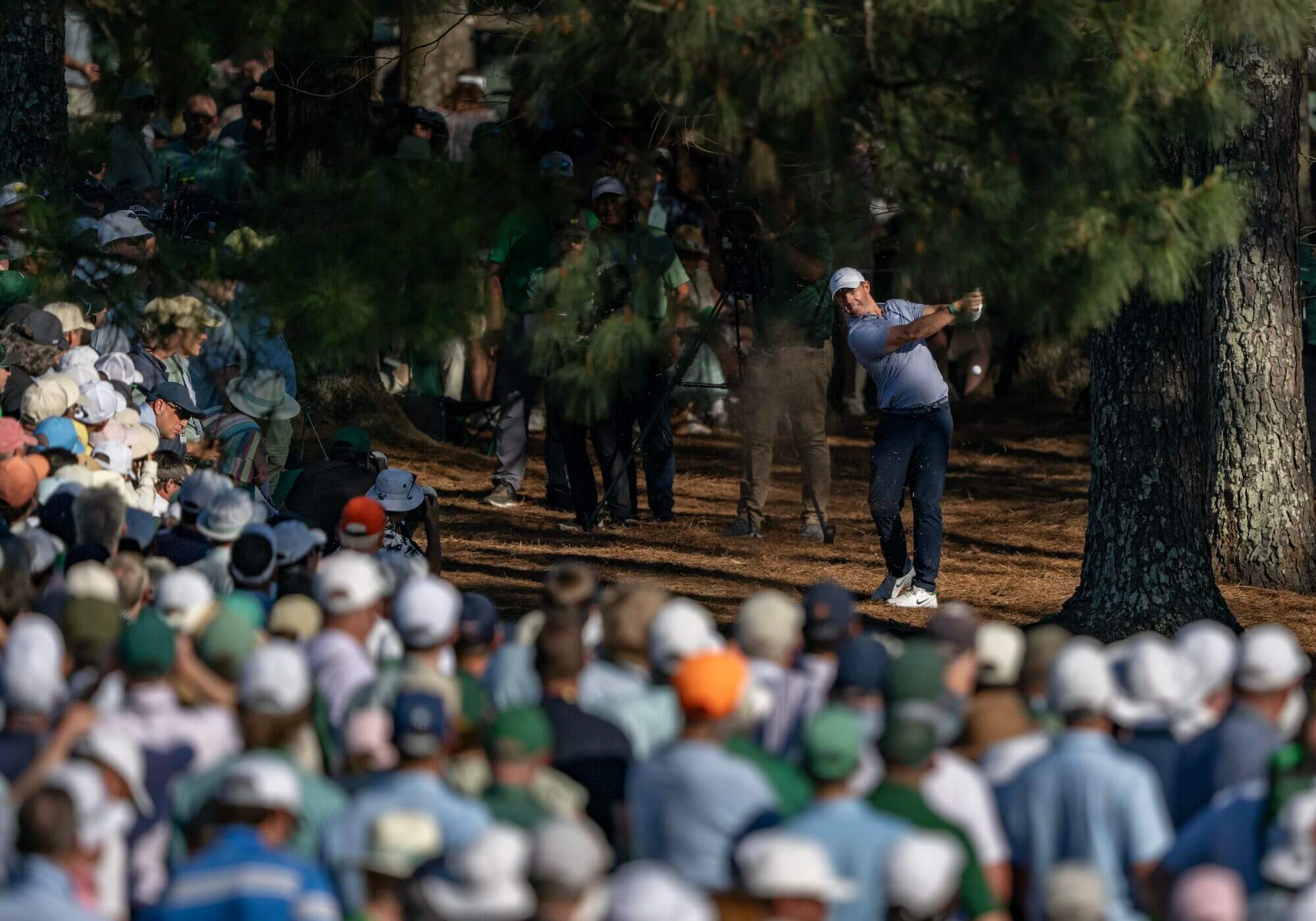
Talk about a niche within a niche within a niche.
Today, we’re discussing the role of trees in golf course design.
Not exactly as controversial as my last Jon Rahm column-There’s still a glare outside my window from the torch-carrying crowd-but it’s still an important issue within golf.
The topic naturally came up this week at Aronimink, host of the PGA Championship.
During the 2018 restoration of Aronimink led by Gil Hanse, many trees were removed as the course returned to its Donald Ross roots. In Ross’s original 1928 design, there were only about a dozen trees on the property. There is much more now, but significantly less than Aronimink had before a 2003 Ron Pritchard restoration and the subsequent 2018 Hanse restoration.
Tree removal is a major trend in modern golf course restoration. Oakmont is a great example. They took out about 15,000 trees and completely changed the color of the course.
However, it’s not just at championship courses like Aronimink and Oakmont. Many restorations and new designs take the approach of fewer trees—or, more accurately, selective tree placement– is an essential element of the course.
Although the practice has come under fire this week, I still think tree removal is a very positive trend for golf as a whole.
Why are trees being removed from courses?
The basic premise of removing trees on golf courses is that it is good for the health of the course on multiple levels.
- Grass is healthier. Grass and trees fight for the same sources of sunlight and water. Trees block the essential morning sunlight and prevent the wind from drying the morning dew. Removing trees improves air circulation and allows the grass to receive more sunlight and water.
- It costs less to stay the course. Trees tend to absorb water and nutrients which can affect other areas of the stream. Removing them helps courses reduce water use and chemical inputs. And tree maintenance costs can be reduced or removed from the budget.
- Better course strategy/playability. Some courses planted trees long ago with the idea that the holes will get stronger over time. But the trees took up a larger area than expected, hampering shots and changing the original pattern of the hole. Removing the tree can restore the intended challenge of the course architect.
Here’s a video of Hanse breaking down the Aronimink restoration and the (limited) role of trees on that course.
Of course, there are some caveats here.
It’s not necessarily about removal ANY tree. It is the selective removal of the tree that is done on purpose.
And that’s not to say that trees in fields are bad across the board. There are many phenomenal courses with trees. Courses without a ton of them can have strategically placed trees that enhance the layout.
However, if forced to choose a side between keeping trees or removing trees on courses, I definitely side with the tree removal crowd.
The health reasons for the course are obvious. It is easier to grow turf in nature and it is more economical not to have trees everywhere.
But the big key for me is the playability element.
Think of all the benefits the average golfer gets from playing a course that is more open. Fewer, if any, missed balls. No knocking out of the woods. Faster pace of the game because we are not wandering around the forest all day. Potentially lower scores and happier players (though not always).
It also opens the door for more strategies. Just because you’re in the game all the time doesn’t mean you’re guaranteed to be in a good position with a great angle to the flag. Wider fairways often offer golfers the opportunity to aim some sides of the freeway or to remove different clubs from the tee. This is a positive.
How tree removal affects professionals
When it comes to challenging the best players in the world, trees are an excellent defender.
The narrow, tree-lined fairways and thick rough would challenge the pros far more than just adding space to the scoreboard.
Additionally, the “width and angles” movement has much less impact on Tour pros who are chipping and hitting wedges on 500-yard par-4s. Angles don’t matter as much when you’re hitting greens with so much loft.
Xander Schauffele touched on this tree debate during his pre-tour press at Aronimink.
“When I hear some designers say, ‘I’m going to put this course back in 1915,’ I think, ‘Well, maybe it takes 100 years for a beautiful tree to grow, just to take it down, just to say it was where it was before.
“I think people keep talking about the distance and the way the game is played, but just put a bunch of trees on a field? I think Hilton Head is a good example. Do I like Hilton Head? Not really. But it’s tough. It’s kind of crazy, if you look at the winning score at Hilton Head and the winning score at Doral, someone is called ‘Hilton Head’ at the bottom. It’s just funny when you look at it that way.”
Let’s also hear from Rahm, one of my favorite voices in golf, when the questions aren’t about his LIV pledge.
“I’ve had this joke over the last few years where I see a lot of golf courses come in saying, ‘Look, 100 years ago, this golf course was like this, there were no trees.’
“While I look at both points, I don’t know which one is more valid than the other. I believe a lot of it has to do with the course conditions … I think the course setup that was expected in the ’30s, ’40s and ’50s compared to what we have now with how tight the grass is and how meticulous everything is, maybe it has something to do with health, I think they have a good thing to do with it. They might have to take those trees out.”
These are very interesting comments from both players. I especially appreciate what Rahm said as he weighed both sides.
My response to Schauffele is that I don’t think golf should focus on the professional game in terms of changing every variable just to challenge the pros. The PGA Championship will come and go, but Aronimink members are playing that course for decades to come.
If courses have to choose between challenging professionals or providing a great experience for recreational players, it is clear that they must choose the recreational experience first.
Are those two things mutually exclusive? Not always. Shinnecock has a tree throughout the course and the winner will be lucky to finish with red numbers due to the course’s consistency and design.
I strongly believe that pros can be challenged in much more interesting ways (course design and setup) than navigating a minefield of trees. It’s not particularly exciting to watch unless it’s a one-off situation like Harbor Town.
And, after all, we cannot provide food everything up to one week a year when the pros are playing a course. There must be a healthy middle ground.
conclusion
Selective tree removal is good for golf.
This makes the game more playable for average players and more efficient for the courses themselves at several levels.
Having a forest of trees would increase everyone’s scores, including the pros. But it wouldn’t really be fun for golfers to play, and it wouldn’t be very interesting to watch professional fighters that way.
What do you think? Is the tree removal trend good or bad for the game? How do you challenge the pros?
Let me know below in the comments.
Top Photo Caption: Rory McIlroy hits a tee shot from the trees. (GETTY IMAGES/Chris Condon)

