


Behind every great World Cup winning team is a great coach. From wartime tacticians to modern data-driven coaches, the men who have guided their nations to football’s biggest prize represent a fascinating cross-section of philosophies, personalities and eras. Here are the the best coaches in the World Cup of all time
Vittorio Pozzo (Italy), 1934 and 1938
He is still the only manager win back-to-back World Cup titles. Pozzo built Italy around the Metodo formation (a precursor to the WM) and used his full authority over the national team, including the controversial call-up of Argentine players, to build a tactically advanced team. Whatever the political context of the time, his record is unique in the tournament’s history.
Helmut Schön (West Germany), 1974
Schön led West Germany to four consecutive tournaments (1966-1978), winning in 1974 with one of the strongest teams ever assembled. BeckenbauerMüller, Maier, Breitner: the backbone of that team was operatic in its quality. Schön provided the structure and calm. The players brought the brilliance.
Mario Zagallo (Brazil), 1970
Zagallo is the only one to have won the World Cup as a player (1958, 1962) and coach (1970). His 1970 Brazil side is often described as the best team ever to play the game. He balanced the attacking talents of Pelé, Tostão, Jairzinho and Rivellino into a coherent and devastating attacking unit. He later returned to coach Brazil in the mid-1990s, winning the Copa América.
Carlos Bilardo (Argentina), 1986
Tactically obsessive and intensely defensive in approach, Bilardo built his 1986 Argentina around one player: Diego Maradona. The 3-5-2 formation he used was unusual at the time and asked a lot of work from his full-backs. It maximized Maradona’s impact while protecting against Argentina’s defensive limitations. The trophy spoke for itself. (POSITION LINK LINK)
Aimé Jacquet (France), 1998
France’s first World Cup victory was under a manager who was openly disliked by the French media and public, until they lifted the trophy on home soil. Jacquet was built around Zinedine Zidane, prioritized defensive solidity (France conceded just two goals throughout the tournament) and relied on unfashionable options like Lilian Thuram in defence. His claim was complete.
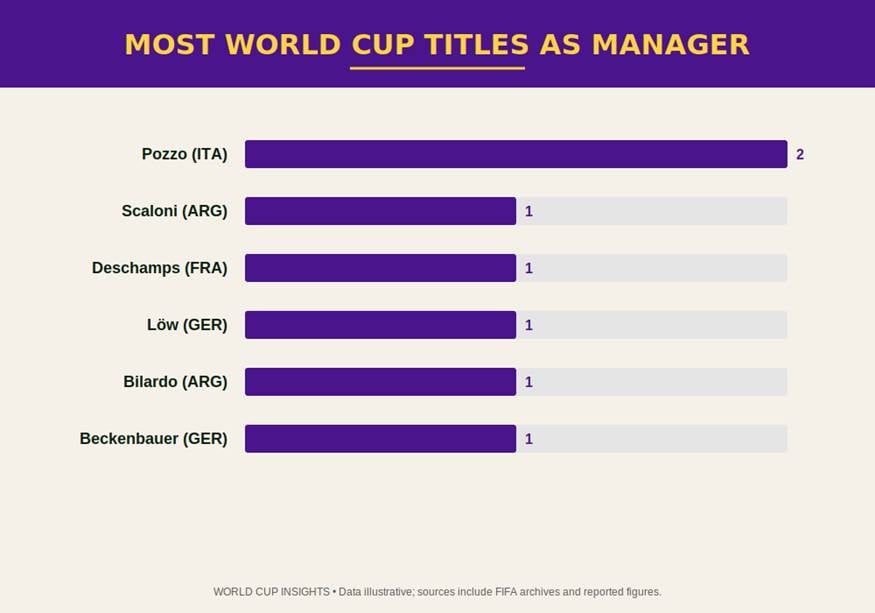
Infographic: World’s most hits infographic as a coach
Marcello Lippi (Italy), 2006
Lippi guided Italy to World Cup victory amid the Calciopoli scandal that had engulfed the country’s club game. His team conceded just two goals throughout the tournament (one of them an own goal) and won the final on penalties against France. Tactical, calm and a brilliant man-manager of a generation that included Buffon, Cannavaro, Pirlo and Totti.
Joachim Löw (Germany), 2014
Löw oversaw a long-term project spanning from his assistant role in 2006 to the 2014 triumph in Brazil. His side combined pressing, technical excellence and clinical finishing. Never more alive than in the 7-1 demolition of Brazil in the semi-final. The trophy was clinched with Mario Götze’s extra-time goal against Argentina.
Didier Deschamps (France), 2018
Pragmatic, ruthless and trophy winner as both player (1998) and coach (2018). Deschamps’ France boasted generational talent in Mbappé, Pogba, Griezmann and Kanté, but never attempted to play ‘beautiful’ football. They counter-attacked, defended at set pieces and won. His team reached another final in 2022, losing only on penalties.
Lionel Scaloni (Argentina), 2022
Promoted from interim to permanent manager in 2018, Scaloni rebuilt Argentina around Lionel Messi, integrated youngsters (Julián Álvarez, Enzo Fernández, Alexis Mac Allister) and ended Argentina’s 36-year wait. Their tactical flexibility, changing shape during and between games, was one of the quiet stories of the tournament. The youngest World Cup winning manager in the modern era.
The modern manager
Modern World Cup management now requires a broader skill set than in any previous era. Selection still matters; tactical setup is still important. But media handling, dressing room politics with player agents, federation diplomacy and the integration of analysis have become essential. Managers with strong club backgrounds (such as Carlo Ancelotti’s various international flirtations) are increasingly finding international management an attractive proposition. Fewer matches but more bets and global recognition. The 2026 cycle has produced an unusually strong cohort of international managers; whoever lifts the trophy will join the previous names.
Who joins the list in 2026?
The eventual winning manager of the 2026 tournament will be added to lists like this one for decades. See how the top contenders handle the longer tournament, increased rotation demands and the inevitable mid-tournament tactical adjustments. Greatness is revealed in all three.
conclusion
Different eras have required different management styles, but the common thread is clear. The best World Cup winning managers have known exactly which players they could rely on and how to build a system around them.

