


Group stage thrashings and predictable knockouts aren’t what make the World Cup memorable. These are the moments when the accepted hierarchy of football crumbles. When a little guy takes down a giant and changes the tournament forever. Here are seven of the biggest World Cup upsets in history, ranked by sheer shockwave.
1. USA 1-0 England, 1950 (group stage)
England were the inventors of the game, World Cup debutants and overwhelming favourites. The United States was a part-time team consisting of postmen, school teachers and a dishwasher. They had lost their previous game 1-0…within 90 seconds. Joe Gaetjens’ first-half header in Belo Horizonte gave the United States a 1-0 victory that British newspapers initially refused to print, assuming the result was a typo. It remains arguably the most shocking result in the history of the tournament.
2. Saudi Arabia – Argentina 2-1, 2022 (group stage)
Argentina arrived in Qatar unbeaten in 36 matches, with Lionel Messi in talismanic form. Saudi Arabia were 1000-1 outsiders for the tournament. Minutes into the half, the Saudis had scored twice through Saleh Al-Shehri and Salem Al-Dawsari. The latter was a thunderous strike that became one of the goals of the tournament. Argentina went on to win the trophy, making the shock all the more remarkable in hindsight.
3. Cameroon – Argentina 1-0, 1990 (Opening)
The current champion, with Maradona at his best, against an African team that had never won a World Cup match. Cameroon finished the opening game of the tournament with nine men and a 1-0 victory, thanks to a François Omam-Biyik header. It heralded African football as a serious force and set the tone for one of the most chaotic World Cups ever played.
4. Senegal – France 1-0, 2002 (Opening)
France were defending champions, European champions and favorites for back-to-back titles. Senegal was a World Cup debutant, made up mostly of players who had grown up in France. Papa Bouba Diop’s twisted goal in the 30th minute has taken the tournament out of its expected axis. France crashed out without scoring a goal. Senegal advanced to the quarter-finals.
5. Germany – South Korea 0-2, 2018 (group stage)
Defending champions Germany needed a win against South Korea to advance. Faced with no goals in stoppage time, the Koreans struck twice with Kim Young-gwon and Son Heung-min on the counter. Germany finished bottom of their group for the first time since 1938. It remains one of the biggest group stage eliminations in tournament history.
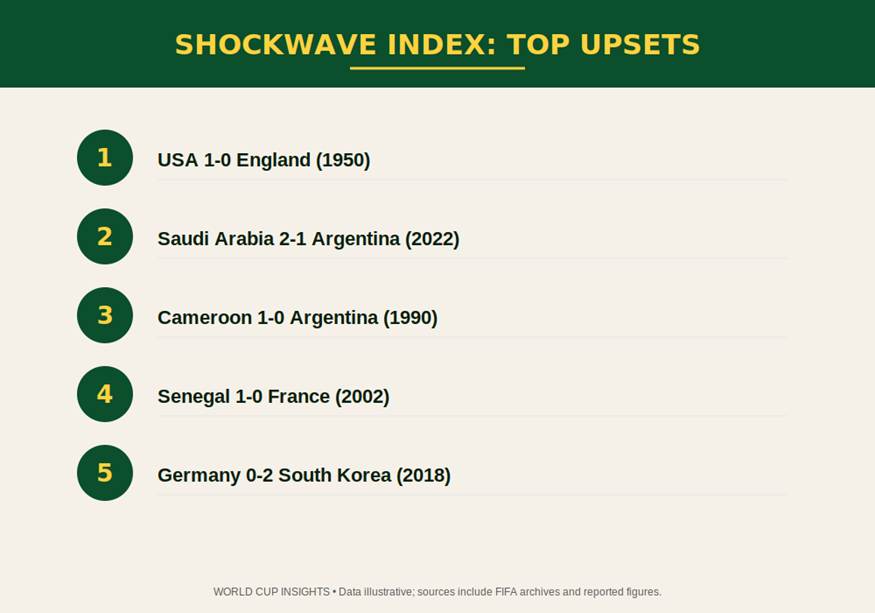
Infographic: Shockwave Index: Top Upsets Infographic
6. North Korea 1-0 Italy, 1966
Two-time former champions Italy were unceremoniously knocked out in the group stage in Middlesbrough by a North Korean side few had even heard of. Pak Doo-ik’s strike sent Italy home with a shower of rotten tomatoes at the airport, literally. North Korea led Portugal 3-0 in the quarter-finals before Eusebio’s heroics turned the game around.
7. Bulgaria – Germany 2-1, 1994 (Quarter-final)
Defending champions, top of the world rankings, leading 1-0 at half-time. Then Bulgaria, with Hristo Stoichkov in inspired form, scored twice in three second-half minutes to knock Germany out. Bulgaria, who had never won a World Cup match before that tournament, finished fourth.
What causes a true disorder?
The largest shocks share three characteristics. A big gap between the teams before the game. High stakes (a knockout or last-day group game). And a result that was not only erased, but felt deserved. Saudi Arabia outplayed Argentina for stretches in 2022. South Korea were faster and sharper than Germany in 2018. The element of validity, not just luck, is what cements a result in the memory.
The psychology of a disorder
Sports psychologists have spent decades trying to understand why heavy favorites lose to underdogs. Common factors include complacency in pre-match preparation, defensive risk aversion when leading or expected to lead, mental rigidity when the underdog scores first and the underdog’s superior emotional energy for 90 minutes. Saudi Arabia’s famous 2022 result against Argentina included almost all of these patterns. Coaches in 2026 will study these games obsessively And bookmakers will price them carefully. But disruptions, by definition, will continue to happen. This is exactly what makes the tournament great.
The next big shock
Every World Cup produces at least one major clash. The names of the giants vary; the script remains the same. Take a closer look at the opening matches and the final group matches. That’s where the biggest upsets come historically.
conclusion
With 48 teams competing in 2026 and an extended knockout phasethe structural opportunity for major disruptions has never been greater. Someone, somewhere, is about to write a new chapter on this list.

