


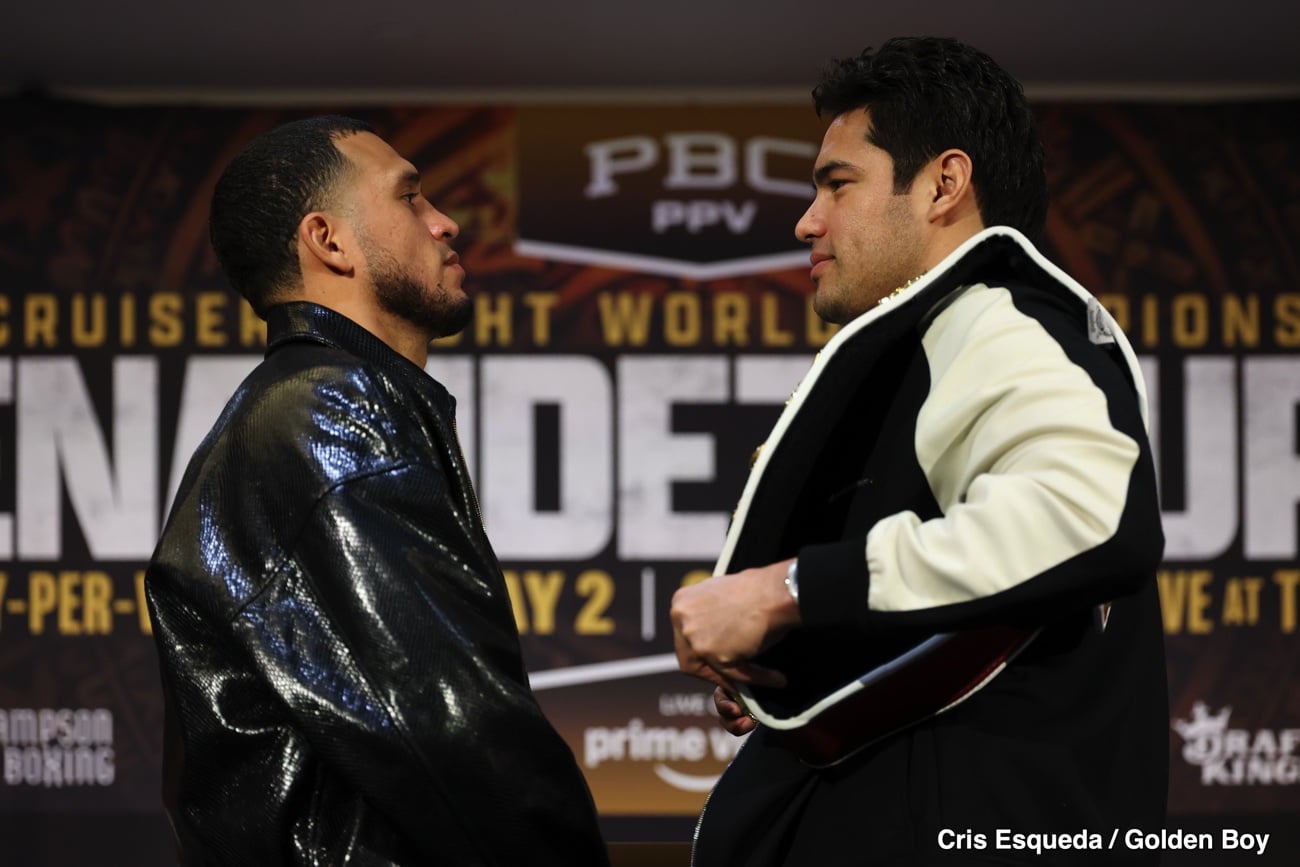


Benavidez created the same problem for competitor after competitor. Fighters may compete early on, but few maintain that level once the rounds build up.
“Guys have good rounds, they don’t have good fights against him. Eventually they wear down mentally, physically, emotionally, and David Benavidez takes over and gets his hand up,” Jones said on Hall of Game.
This became the main selling point of Benavidez. His pressure doesn’t always win the first few minutes, but it often changes the entire fight once opponents start reacting instead of working.
However, Jones doesn’t see Ramirez as a helpless underdog. He pointed to the Mexican southpaw’s experience, height and consistent style as reasons why the fight could become difficult if Benavidez can’t break him down early.
“If Zordo Ramirez can weather those storms without taking too much punishment and keep that thing tight in the back half, he’s got a chance,” Jones said.
Ramirez has won titles in multiple divisions and has shown he can fight at a measured pace without giving away cheap rounds. This can matter against an opponent who thrives when exchanges become rushed and chaotic.
Gilberto Ramirez has acclimated to the higher weights in recent years, and his frame at cruiserweight is obviously broader than what David Benavidez faced.
The punishment that Benavidez took against Oleksandr Gvozdyk and David Morrell Jr. was however clear. While he won both fights by unanimous decision, those victories were different from his search-and-destroy runs at 168.
In his light heavyweight debut against Gvozdyk, Benavidez admitted he had injuries, a torn hand ligament and a cut, forcing him to box more conservatively. He dominated the first half, but the punching statistics showed a significant tightening in the later rounds.
Benavidez outscored Gvozdyk 107 to 57 in rounds 1 through 5. In the final seven rounds, that gap closed to a much smaller 116 to 106.
Against Morrell, it was a bruising encounter where Morrell’s athleticism and power forced Benavidez to absorb heavy shots. Even though the scorecards were clear (118-108, 115-111, 115-111), Benavidez finished the fight looking better than usual.
The jump to fight Ramirez for the cruiserweight title represents a 25-pound increase from Benavidez’s longtime home at super middleweight. Critics argue that if Gvozdyk and Morrell could find openings at 175, a naturally bigger champion like Ramirez would have the durability to ignore the “Monster” volume and land more counters.
Ramirez thrives when he can use his reach to keep opponents on the receiving end of his punches. The big question is can Ramirez move enough to really stay out of the line of fire? Since moving to cruiserweight, his footwork and ability to turn his opponents has been surprisingly sharp.
In his wins over Arsen Goulamirian and Chris Billam-Smith, he used his 6’2″ frame to reset the distance every time things got hairy. However, David Benavidez is a completely different animal than Billam-Smith.
While Ramirez’s movement looked good against guys coming forward in straight lines, Benavidez is a master at cutting off the ring and throwing in combinations that catch fighters even as they try to move away.
Ramirez tried to use movement against Dmitry Bivol at 175, and we saw how that went. He couldn’t keep up with the technical rhythm and ended up losing a clear decision. Benavidez is not as neat as Bivol, but his pressure is much more physical.


