


What’s next for LIV Golf?
Jon Rahm sounds as curious as anyone.
“I don’t think he would ask anybody to buy anything without first giving us a business plan,” Rahm said Tuesday. “Until we have that, I don’t think we can really answer the rest, can we? It would just be speculation at that point.”
Rahm, the league’s top and highest-paid player, was speaking at a pre-tournament news conference ahead of LIV Golf Virginia, which begins Thursday amid clouded questions about the league’s future. Last week the Saudi Public Investment Fund DESIGNATED that it will cease funding the league at the end of 2026; now it’s a question of what will happen in 2027.
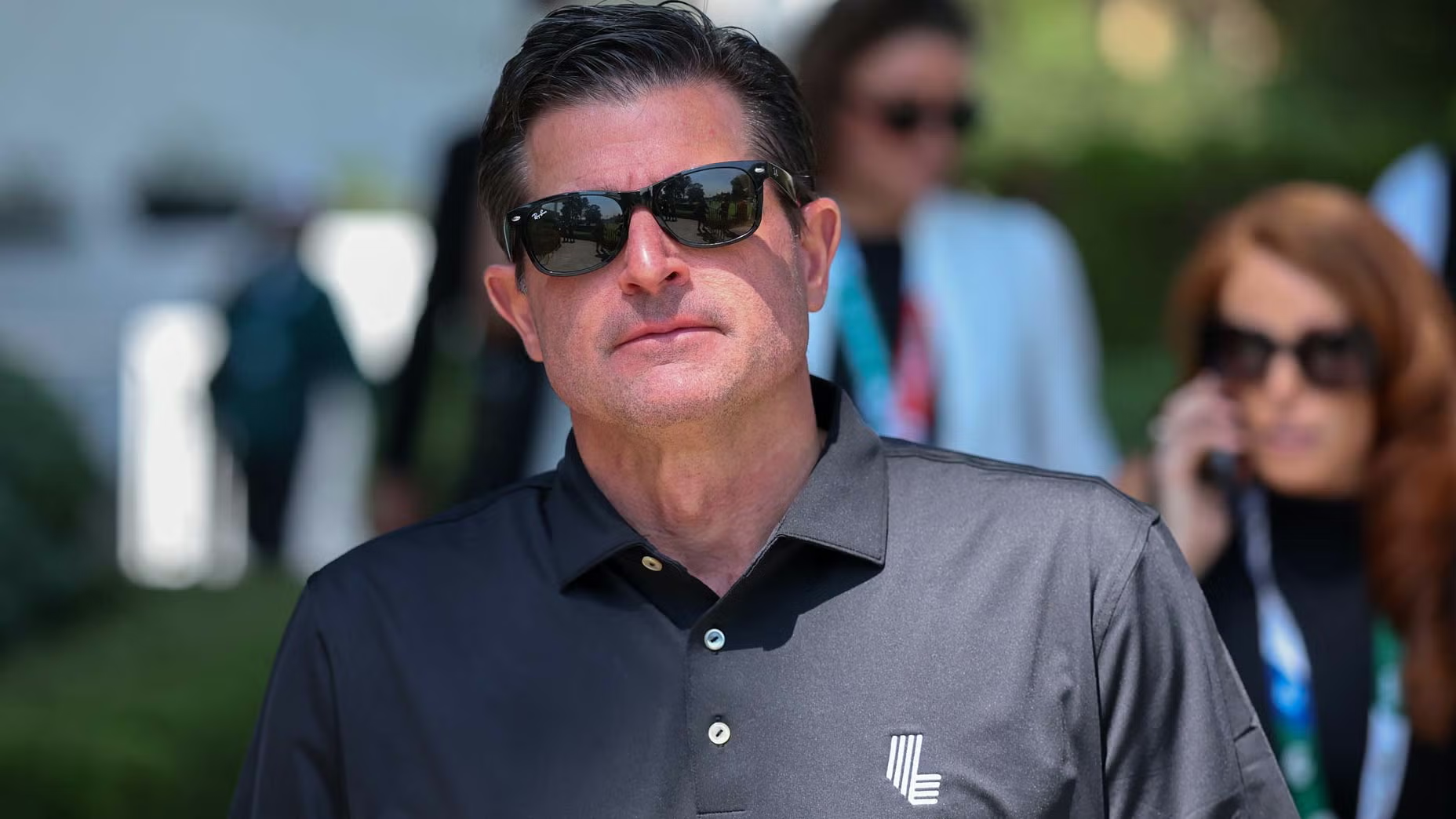
The “one” Rahm referred to is Scott O’Neil, CEO of LIV Golf, who appeared Tuesday for the first time since the PIF was announced. He first answered questions from LIV’s head of communications, Ilana Finley, and then from a panel of reporters. And while we, like Rahm, will have to wait for specifics about that plan, O’Neil revealed a lot in the 45-minute session. Let’s run through what we learned—and what we didn’t.
1. If LIV Golf plays, it will change radically
This was the reality once PIF withdrew its funds; there’s no way new investors will sign up for LIV’s current financial reality, which is said to include a nine-figure monthly rate.
But it was interesting to hear Finley, the CCO, use phrases like “resetting the business plan” and “committing the players to a new model,” while O’Neil said it’s been clear for more than a year that LIV’s model would need “significant and fundamental changes” — openly admitting that the league’s business plan is essentially starting from scratch.
O’Neil laid out the plan – or plan to make a plan – as follows:
“The priorities are really clear. First and foremost, we have to get the players on board and focus on golf. That’s first and foremost,” he said.
“Secondly, we need to create a plan that is a business plan, a business that works from a business standpoint, from a profit and loss standpoint, like any other business in the world, and we’re well on our way to that.
“Third and perhaps most important—and I’ve been blessed with this my whole life—is that you surround yourself with smart, talented, experienced people.”
2. LIV relies on new advisors to help with restructuring
LIV added two new board members, Gene Davis and Jon Zimman, investment bankers adept at businesses in flux; Davis’ recent “turnaround management” experience includes high-profile jobs with Spirit Airlines.
“Gene has been through 350 of them, how about that?” O’Neil said, praising the duo’s “urgency” and “pace.”
LIV has also brought in financial advisory firm Alix Partners, which specializes in restructuring and restructuring. O’Neil called them “outstanding advisors” looking to extend the league’s runway.
LIV continues to rely on the law firm Gibson Dunn, as it has on various high-profile litigation chapters since its inception.
And LIV has brought on board Ducera Partners, with which O’Neil has history, as an investment banking adviser, as it tries to transform its business model.
“We’re locked into going to market with a plan. That’s transaction, transaction, transaction. That’s what I wake up thinking about. That’s what I go to sleep thinking about. That’s what I think about when I’m eating. That’s what I think about when I’m on the golf course,” O’Neil said.
3. O’Neil sees himself as a wartime CEO
O’Neil acknowledged LIV’s precarious position, but said he relishes this kind of chaos, what he called “the opportunity for transformation.”
“I understand that uncertainty is difficult for some people and I understand that not knowing what tomorrow brings can be a challenge,” he said. “This is 100 percent what I love to do, this moment. Everyone is made for a certain thing in their life. I believe this is what I am meant for. I love this moment.”
4. PIF’s withdrawal has O’Neil in a tricky spot
O’Neil has a tricky line to walk with the sudden withdrawal of PIF funds. The project is shaken and he seems unprepared. Say he saw it coming and he seems to be hiding something from his players. Ultimately, O’Neil told LIV players that the league’s funding was secured for another five years. On Tuesday, he defended himself by suggesting it would be “naive to be surprised” by their sudden announcement.
“Was I surprised? I don’t know, it’s hard to even think about that moment. So I’d rather not comment on how I really felt, my emotion. I can tell you that it was very clear 18 months ago that this was going to be an ongoing concern, that we were going to have to make significant and fundamental changes in terms of how we do business,” he said. He continued:
“So it would be naive to be surprised, and it would be irresponsible to think about anything other than how far we have to go to make sure we can continue to develop this game around the world.”
5. He sees LIV Golf as a “mission”
The biggest fundamental question LIV now faces is that why. Why does it exist as an alternative to the PGA Tour and DP World Tour? What is his identity? Team golf is a differentiator, but O’Neil also repeatedly brought up the idea that it’s a mission-based organization.
“I’ve been around professional athletes for the last 30 years of my life, and I’ve never been around a more remarkable group of men who believe in the mission to grow the game of golf around the world, who are willing to get on a plane and travel and make it happen, who stand for hours in the scorching heat after a brutal round and spend time with you, your oldest sons. DeChambeaus — autograph signing for hours He also added that the “anxiety” and “controversy” of LIV’s uncertainty has been partially washed away, “because our mission is so clear, and that is to grow the game of golf around the world. Part of that is us going door to door.”
6. He sees the value of LIV in its franchises
O’Neil brought up several memories of the rise in American sports valuations — the Utah Jazz from $13 million to $1.8 billion, the Philadelphia Eagles to over $8 billion, the rise of the NWSL and WNBA — to introduce the idea that LIV teams can be worth a lot of money, too.
“If you ask me where the value of this business is, it’s in the teams. If you’re looking for direction, we believe the teams will be of tremendous value,” he said. “We believe that once we get the business in the right direction with the right trajectory, with the right revenue base and cost base, which we’re well on our way to doing, that these teams will have tremendous value. And that’s where, if you’re an investor and you’re listening to this or reading this, that’s where you’re going to get your value.”
But how would selling a specific team work?
“We’re going to create a business plan. We’re going to link arms with the players. We’re going to go to the market and raise money at the top, at the league level, and then we’re going to go and get investors in the teams, that way.”
7. Player salary remains a massive unknown
O’Neil was asked if the PIF was committed to paying any player contracts that extend beyond the 2026 season. “I don’t even know how to think about answering (that),” O’Neil said.
He underscored the partnership between league executives and players — “There’s no light between what I’ll know and what Bryson, Jon, Phil, Bubba, Cam or DJ will know,” he said, but because future funding is unknown, the players’ salary is, too.
Rahm actually took this question further in his presser:
“I believe that for the business plan to change, whatever they come up with, there will have to be some concessions on our part, yes,” he said.
8. Bryson DeChambeau’s situation is “special”
LIV’s most important player, Bryson DeChambeau, is only signed through the end of 2026. His commitment to the ongoing league — or lack thereof — would have a massive impact on potential investors.
“Well, that’s an interesting question. I’m not sure. We’ll adjust and work,” O’Neil said of hitting the market with or without DeChambeau under contract. “I appreciate the question. It’s just — Bryson’s special. He’s different and special. You want to talk about a business partner, we’re literally talking about the future of LIV Golf, I’m talking to him about how he sees, not just golf, but the business? He’s smart, he’s driven, he’s dedicated, and he’s a partner.”
9. O’Neil took some pictures on the PGA Tour
The LIV CEO praised team golf as a reason to believe in the league’s future, citing the impact of the Ryder Cup and “the impact that the Presidents Cup had when it had all the best players in the world playing in it.” The Presidents Cup is owned by the PGA Tour and therefore has barred LIV golfers from being accepted to the American side (like DeChambeau) or the international team (like Joaquin Niemann, among others).
He returned to that point later, calling out the Tour for banning LIV players from playing PGA Tour events within weeks.
“We’ve never, since our inception, restricted our players — that’s from bans, from fines, not us. No, go play wherever you want to play. We believe in free golf, free agency golf. We believe players should play when they want and where they want as long as they sign up for those 14, and we’re going to stick to that.
It is worth noting that LIV golfers are restricted from playing PGA Tour events during LIV weeks, nor can PGA Tour players earn entry into one-time LIV events.
10. O’Neil believes there is interest from investors
While some experts have dismissed LIV’s viability, O’Neil projected confidence. He cited the crowds at successful events like LIV’s stop in Adelaide, Australia, and its debut in South Africa, which each drew over 100,000 spectators during the week. He cited the “nationalist movement” as teams such as the all-Aussie Rippers, South Africa’s South Guard or the Korean Golf Club have been formed.
He called for increased corporate partnerships with big brands such as Rolex, HSBC, Salesforce and Qualcomm. He added that he was encouraged by the recognition of LIV from major championships. And he said the players themselves have provided leads to potential investors.
“I’ve had about a dozen incoming calls this weekend, incoming from potential investors, which is good news,” he said. “So it was a split between private equity, family office and then your traditional like high net worth — you probably know who they are, the guys who invest in sports and sports teams. So that’s been really positive.”
LIV Golf continues. The question that remains is where it is going.
“>

