


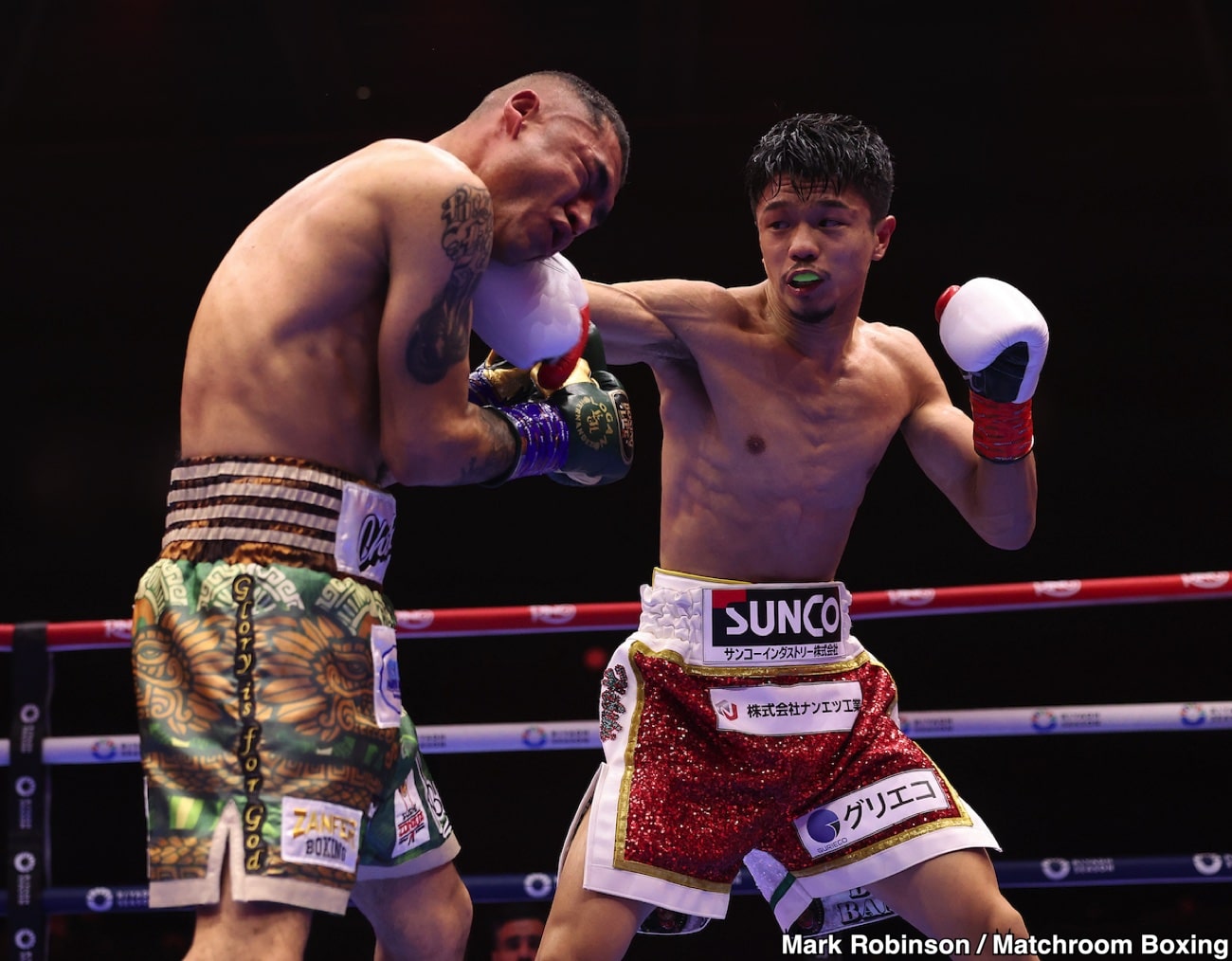


“I feel like my size and youth should be a huge advantage. It gives me an even better chance to win,” Nakatani told The Ring.
Inoue’s reluctance to jump at featherweight to 126 pounds may be the most honest acknowledgment of his physical limits.
Inoue has fought guys who have rehydrated to be heavy, but Nakatani is tall. At 5’7″ or 5’8″, he has the skeletal leverage of a natural featherweight or super featherweight.
Most of Inoue’s opponents end up getting time because they have to jump in to hit him. Nakatani can theoretically sit on the outside and squeeze a jab without putting his chin in the red zone.
The numbers confirm that belief on paper. Nakatani will come in with a three-inch height edge, a slight reach advantage and a five-year age difference. He also carries natural size from his climb through three weight classes, something he plans to use over the full distance rather than chasing an early finish.
“This fight will be 100 percent a war, and I think I will win by decision after overcoming everything Inoue throws my way,” Nakatani said.
In his December win over Sebastian Hernandez, Nakatani was forced into a high-output fight where both men landed heavily and absorbed 273 punches in a back-and-forth contest that went the distance. That showed durability, but also suggested he could be hit when trades open.
It’s less about Inoue being afraid to fight a bigger opponent and more about him being a perfectionist who knows that once you lose the physical edge, you have to rely entirely on toughness. Nakatani is the first fighter in a long time who might actually make Inoue look small in the ring.

