


African football’s relationship with the FIFA World Cup is a story of slow recognition, spectacular breakthroughs and constant, sometimes frustrating, progress. From a single allocated place in 1970 to Morocco’s historic semi-final in 2022, the journey of the continent’s tournament reflects both how much has changed and how much remains to go even with shocking results like Cape Verde’s goalless draw with Spain to the World Cup 2026.
The long road to inclusion
The first FIFA World Cups featured African teams only sporadically, often relegated to playoffs against European or Asian opponents. Emergence of Egypt in 1934the first on the continent, was followed by an absence of 36 years. It was not until 1970 that Africa was guaranteed at least one direct slot. Morocco filled it that year and held on, drawing with Bulgaria and narrowly losing to West Germany. The continent now has five guaranteed slots, soon to be nine in the expanded 2026 format.
Cameroon 1990: The Breakthrough
If African football has a single foundational World Cup moment, it is Italy 1990. Cameroon, led by 38-year-old Roger Milla and his corner-flag celebrations, beat defending champions Argentina in the opening match, won their group and reached the quarter-finals. They lost 3-2 in extra time to England in a thriller. They were two minutes away from a semi-final. The team’s drag and Milla’s joy made the world re-appreciate what African football could be.
The Generation of Senegal (2002)
Senegal’s tournament debut in Korea/Japan 2002 began with another first shock. 1-0 victory over reigning champions France. Coached by Frenchman Bruno Metsu and built around El Hadji Diouf and Henri Camara, they reached the quarter-finals before falling to Turkey by a golden goal. Combined with Cameroon’s decade-long near-misses, the period firmly established African football as a force capable of quarter-finals.
Ghana 2010: So close
South Africa 2010 was the first World Cup on African soil, and Ghana came very close to making the tournament’s host continent proud. In the quarter-finals against Uruguay, Asamoah Gyan missed a penalty in the 120th minute (after Luis Suárez’s handball) that would have sent Ghana to the semi-final. They lost on penalties. It remains one of the cruelest moments in African football. And a disturbing “what if” for the entire continent.
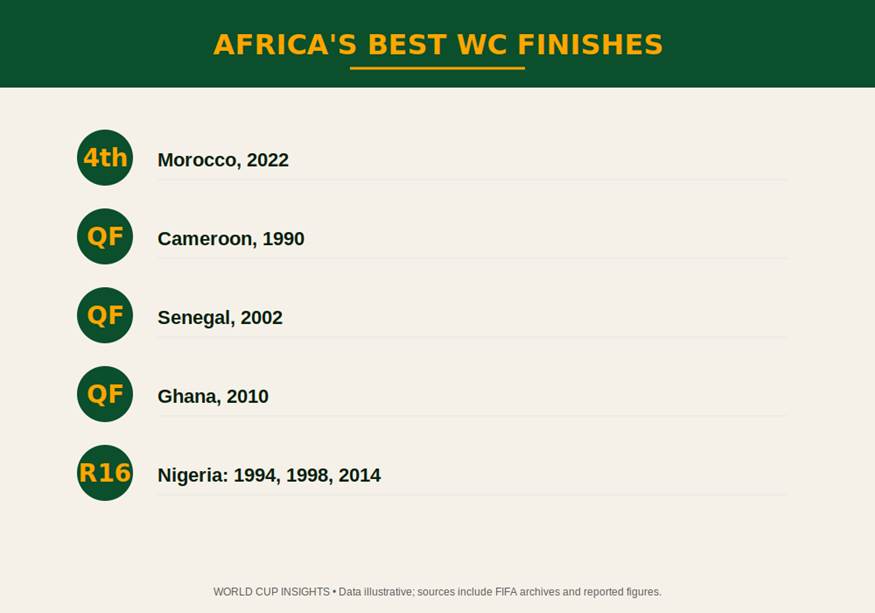
Infographic: Infographic of the best toilet finishes in Africa
Morocco 2022: Semi-final
Walid Regragui’s Morocco changed everything. Topping a group consisting of Belgium and Croatia, they defeated Spain and Portugal in successive knockout rounds to become the first African nation to reach a World Cup semi-final. They narrowly lost to France, but their run captured the imagination of the entire continent and the Arab world. Goalkeeper Yassine Bounou, midfielder Sofyan Amrabat and the team’s defensive structure became benchmarks of tournament football.
Why African teams have historically underperformed
Despite the highlights, African nations have collectively underperformed their talent pool. Reasons cited by coaches and analysts include federation instability and late coaching appointments, disruption to the Africa Cup of Nations fixture list (the tournament’s mid-season), travel and player release issues, and a lack of investment in youth development infrastructure compared to European setups. Many of these are slowly changing. Morocco’s 2022 squad was the product of years of systematic investment by the federation.
The 2026 perspectives
With nine African spots guaranteed in 2026 (up from five in 2022) and stronger sides emerging in Senegal, Morocco, Algeria, Nigeria and a resurgent Egypt, the continent has its best collective chance in history. Morocco enters the tournament as one of the true outsiders. Senegal, current winners of the AFCON in recent cycles, remain dangerous. Depth has never been better.
Investment and Infrastructures
Several African federations have copied Morocco’s model in recent years. Long-term coaching contracts (Walid Regragui was appointed less than three months before Qatar 2022 but had been in Moroccan football for years), investment by the federation in academies (the Mohammed VI Football Academy is now a regional power) and active integration of dual-national players based in Europe. Senegal, Algeria and, increasingly, Nigeria are following similar paths. The infrastructure gap between African football and its European or South American counterparts is closing. Slowly, but visibly. The 2026 expansion provides a much larger stage on which to demonstrate this progress.
Looking forward to 2026
With nine African venues in 2026, several teams are expected to advance from the group stage. A second African semi-finalist would be plausible. A first African runner-up would still be a major story. But the structural barriers to that are smaller now than at any time in the tournament’s history.
conclusion
The story of the African football World Cup has gone from “happy to be there” to “capable of beating anyone” in about thirty-five years. The next jump, a real finale, feels closer than ever.

