


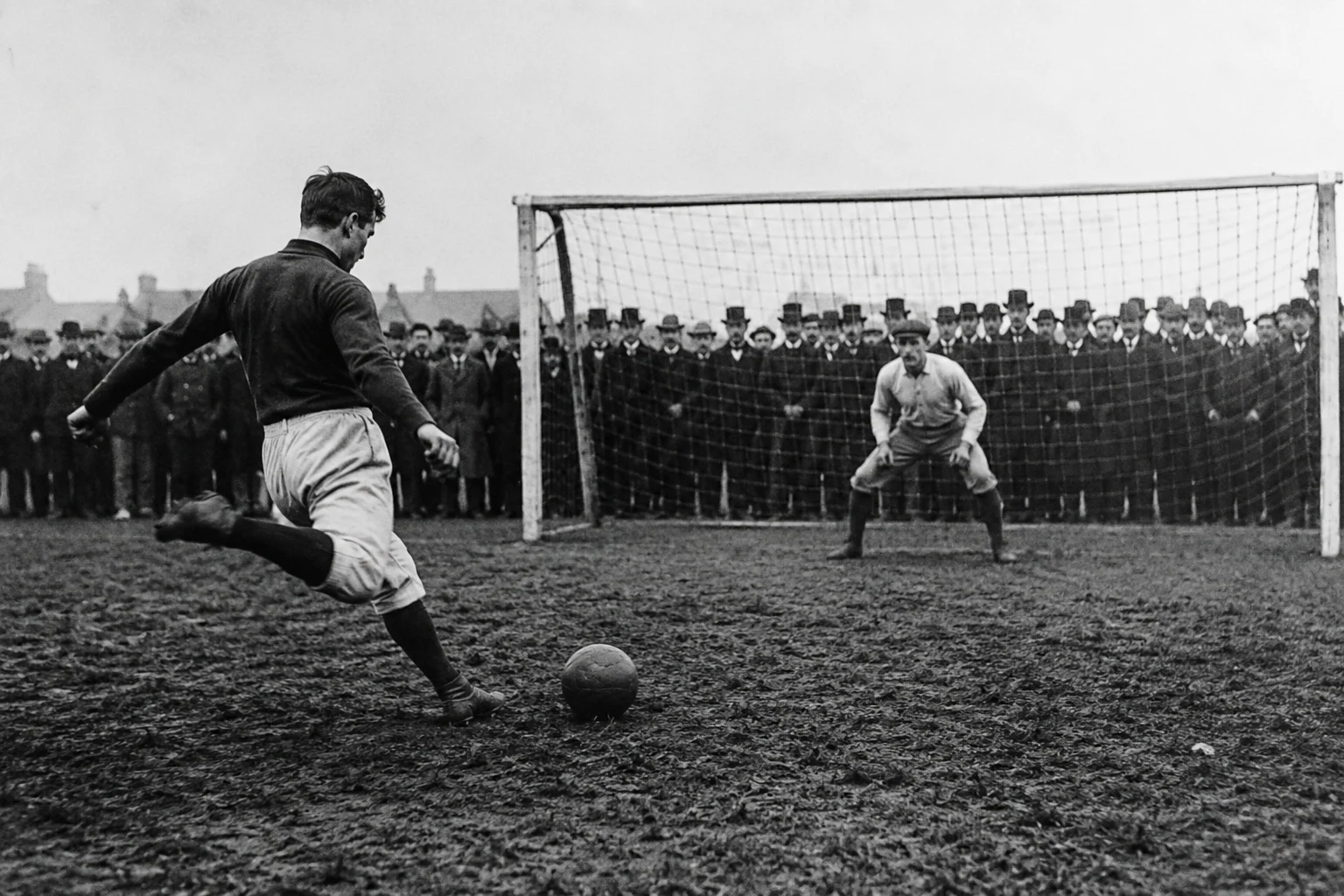
In the modern game, the penalty kick is football’s great draw and its most theatrical moment. Tournaments are decided by her. Throughout football history heroes and villains are made in twelve meters of grass. However, for the first quarter century of organized football, there was no such thing. The founders of the sport considered the very idea of a penalty kick to be not only unnecessary but morally offensive. The man who forced it into existence was a County Down goalkeeper called William McCrum, and the story of how he did it is one of football’s quieter chapters.
A game based on trust
When the Football Association codified the laws of the game in 1863, he did so under a peculiarly Victorian assumption: that gentlemen would not cheat. The rules were few, the punishments minimal. If a defender deliberately handled the ball on the goal line to prevent a certain score, the referee could award a free kick, but this free kick could be taken from anywhere, and if it was inside the penalty area, the defending side could simply form a wall on the goal line and block it. The cynical defense was indeed rewarded.
For decades this caused little controversy because the men who played the game were largely public schoolboys and college graduates for whom deliberate foul play was unthinkable. The amateur ethos held that football was a contest of skill and character, and that breaking the rules on purpose was morally disqualifying, regardless of what the referee saw. To suggest that a player could deliberately cheat was, in the parlance of the time, “ungentlemanly”.
But football was changing. By the late 1880s, the sport had spread from its birthplace in Oxbridge to the industrial north of Englandto Scotland and across the Irish Sea. Workers’ clubs became professional. Salaries were paid, leagues were formed and points mattered. The amateurish assumption that no one would ever cheat began to seem curious.
A keeper from Milford
William McCrum was the son of a wealthy cloth manufacturer in the village of Milford, outside Armagh, in what is now Northern Ireland. He was, by most accounts, a flamboyant character—fond of the theatre, cricket, the odd gamble—and an enthusiastic, if not particularly distinguished, wicketkeeper. His club, Milford FC, played at the opening Irish Football League in 1890–91 and lost every match. McCrum himself was reported to have conceded sixty-two goals in fourteen games.

From this unenviable vantage point, McCrum had a clearer view than most of football’s emerging crisis. He saw forwards get down on goal only to be pulled back, tripped or punched in the ribs by defenders who calculated, correctly, that a free-kick from an obstructed angle was a price worth paying. He saw deliberate handballs on the goal line. He saw, ultimately, the gap between the game of knights that the founders had envisioned and the game that was actually being played.
In 1890, McCrum drafted a proposal for a new rule. Any deliberate foul committed by the defending team within twelve yards of their own goal line would result in a direct kick at goal, taken from a marked spot, with only the goalkeeper authorized to defend. He presented the idea to the Irish Football Association, who passed it on to the International Football Association Board.
The indignation
The reaction from the English football establishment was something close to fury. CW Alcock, secretary of the Football Association and one of the most influential figures in the sport, publicly opposed the proposal. Corinthians, the big fan club whose England internationals were there, declared the rule an insult. To accept the penalty, they argued, was to admit that footballers could deliberately cheat. It was, in the phrase that became famous, “the death of the knight’s game.”
The Corinthians’ protest went beyond rhetoric. Whenever they were awarded a penalty in the early years of the rule, their goalkeeper would stand aside and let the shot go into the net, refusing to dignify the foul play charge by attempting a save. The gesture was intended as a moral statement. He mostly just lost them games.
Despite opposition, the IFAB approved McCrum’s proposal in June 1891. The penalty, initially called the “kick of death” by skeptical English newspapers, entered the laws of the game on 2 September 1891. John Heath of Wolverhampton Wanderers converted the first in a Football League game a fortnight against Accrington.
The Slow Vindication
The new rule did not solve everything at once. The original version allowed the kick to be taken from anywhere along a twelve-yard line drawn across the field of play, not from a single point, and allowed the goalkeeper to advance up to six yards. The family penalty point did not appear in the laws until 1902, when the rectangular penalty area was also introduced. The goalkeepers were restricted to their goal line soon after.
But McCrum’s central idea, that a sport ruled by honor alone cannot long survive contact with money and ambition, proved enduring. Every modern penalty in football, from red card to the VARdescends in spirit from his Milford proposal. He is the reason why a deliberate handball on the line is not a tactic but a calamity.
McCrum himself died poor in 1932, having squandered the family fortune on bookmakers and the theatre. There is now a small park named after him in Milford, with a plaque naming him the inventor of the penalty. It’s a modest tribute to a man whose unique rule change shaped the sport more than the careers of most players who ever lived.
The next time a penalty decides a final, it might be worth a thought for the losing County Down keeper who saw what the gentlemen couldn’t.

