


I’ve always lived and played golf near sea level: New York, Florida, Georgia. This is the golf I know.
But I have family in Denver, and every time I go out there and play, it feels like a whole different game.
At first, it’s an ego boost, especially with the driver. Then it gets frustrating.
Because calling in pitch distances isn’t as simple as picking up one less club. The numbers don’t quite match up. If you have a golf trip coming up or are moving somewhere with higher (or lower) elevation, this information should help you get your yards under control faster.
What happens to the golf ball at a higher altitude
Height does not change swing speed or how fast the ball leaves the clubface. What changes is what happens after impact.
At higher altitudes, the air is less dense, so the ball faces less resistance as it travels. It maintains speed longer and takes it farther.
The important part for golfers is that this is not a flat push of the yard across the bag. Elevation works more like a percentage increase, which is why your driver may gain a little while a wedge changes a little.
The Altitude Formula (And Why There Are Some Variations)
If you look at the height adjustments, you’ll find slightly different numbers depending on the source.
Most fall into a fairly narrow range:
- Around 1.1 to 1.6 percent more distance per 1,000 feet of elevation
You’ll occasionally see some sources talk about a two percent rise per 1,000 feet, but that’s a bit strong. For this chart, we’re using a simple middle number:
- 1.2 percent more distance per 1,000 feet of elevation
It is easy to apply, consistent with launch monitor the patterning and lines match well with what players typically see in places like Denver (~5,000 feet) where carry distances are often about six percent longer.
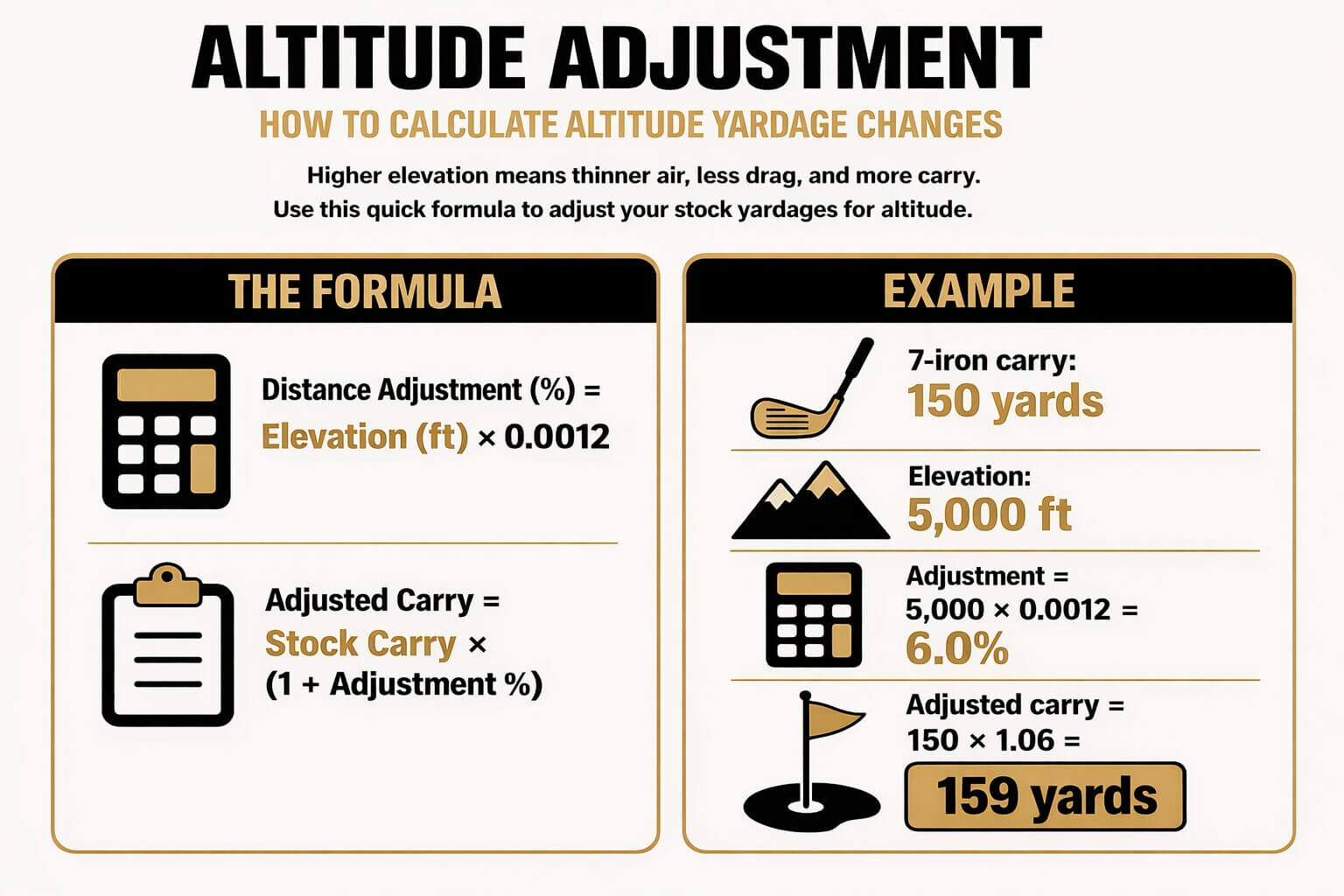
Golf distance chart for elevation
Here’s a simple way to implement it without having to calculate anything in between. These are carry distances, not totals, and because height works as a percentage change, longer clubs will see greater gains than shorter ones. A wedge won’t change as dramatically as a mid-iron or fairway wood, but once you get into the 3,000-foot mark, the differences become much easier to notice.
| Height | % Increase | 150 yd shot | 200 yd shot | 250 yd shot |
|---|---|---|---|---|
| Sea Level | 0% | 150 | 200 | 250 |
| 1000 ft | 1.2% | 152 | 202 | 253 |
| 2000 ft | 2.4% | 154 | 205 | 256 |
| 3000 ft | 3.6% | 155 | 207 | 259 |
| 4000 ft | 4.8% | 157 | 210 | 262 |
| 5000 ft | 6.0% | 159 | 212 | 265 |
| 6000 ft | 7.2% | 161 | 214 | 268 |
| 7000 ft | 8.4% | 163 | 217 | 271 |
| 8000 ft | 9.6% | 164 | 219 | 274 |
A quick note on ball spin and flight: The golf ball does not spin less at altitude. What changes is that the air is less dense and applies less force to the ball in flight, so the lift is lower. On longer shots, this can lead to a flatter trajectory, a shallower descent angle and more spin. The ball also won’t chip or snap as much, which can make it a little more difficult to form shots. In shorter shots, the effect is much smaller.
How TrackMan Normalization Fits
If you’ve ever used a launch monitor and seen a “normalized” number, that’s exactly what it’s calculated for. Normalization adjusts your photo to a standard setting:
- Sea level
- Neutral temperature
- Standard air density
This allows a shot in Denver to be directly compared to a shot in Florida.
For professional players, this is very important. They are constantly traveling between events at different altitudes and need a stable base for transport distance and gap. For everyday players, it’s a good reminder that your yards aren’t just about your swing. They also have to do with where you are playing.
Final thoughts
Keep this chart handy the next time you play at a higher altitude. The biggest mistake is trying to force a “one less club” rule through the bag. Height adjustments work best when you know the carry distances and use those numbers as a starting point.

