


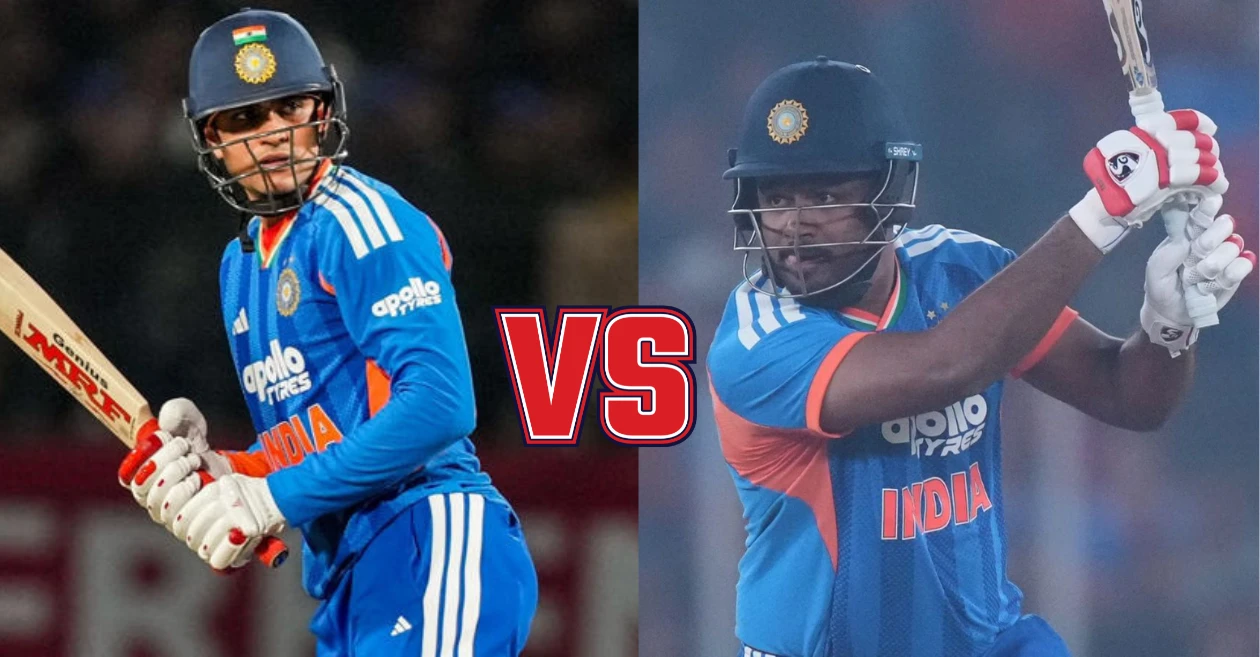

As India pre-adjusts its squad composition ICC Men’s T20 World Cup 2026a clear statistical and tactical gap has emerged between Sanju Samson and Shubman Gill. While Gill’s overall generation and peak performances cannot be ignored, Samson’s T20I numbers, strike rate and role versatility have given him a decisive edge in the World Cup competition.
Selectors and analysts agree that the modern T20 template requires explosive power output and consistency – areas where Samson has consistently outperformed Gill in the larger sample size.
Shubman Gill vs Sanju Samson: Overall T20I career comparison
A look at their T20I career numbers highlights the contrast in approach:
Shubman Gill: 36 matches, 36 innings, 869 runs, average 28.03, strike rate 138.59, one century, three fifties, highest score 126 not out
Sanju Samson: 52 matches, 44 innings, 1032 runs, average 25.80, strike rate 148.06, three centuries, two fifties, highest score 111
Gill’s standout remains his 126 not out against New Zealand, which briefly propelled him into the elite T20 discussions. However, this summit was not continued. Samson, on the other hand, has maintained a career strike rate of over 145 in a significantly greater number of matches, cementing his reputation as a highly effective T20 batsman.
Gill’s extended lean patch in T20Is
One of the biggest factors that cause damage Gill has been in form for a long time. Despite his early promise, Gill went 18 T20I innings without a half-century until 2025, with his returns plummeting.
In 15 T20Is in calendar year 2025, Gill managed a total of 291 runs at an average of 24.25, which came to around 137. Those numbers were well short of the aggressive power play selectors actively sought for World Cup conditions where fast starts were out of the question.
Samson’s current form matches are running
Interestingly, Samson scored the same number of runs as Gill in the last 15 T20Is, but did so at a higher strike rate of 137.26 while showing more intent during the power play. That aggression – especially against pace in the top six – was a critical selection criterion for the World Cup squad.
Although Samson’s average remains slightly lower, selectors value impact per ball more than time spent at the crease in T20 cricket. In this metric, Samson consistently excelled.
Apart from pure batting numbers, Samson offers two major advantages that Gill does not. The first is the wicketkeeping skill which allows India an extra batter or bowler field depending on the conditions. The second is his versatility, with the ability to bat anywhere in the top four, adapting to different match situations.
This flexibility significantly improves the balance of the squad, especially in a 15-man T20 World Cup squad where every role needs to be covered without redundancy.
Also READ: Fans were shocked as BCCI dropped Shubman Gill from India’s T20 World Cup 2026 squad.
Why did the selectors back Samson over Gill in India’s T20 World Cup 2026?
Not a talent judgement, but a special challenge for T20
Batting analysis sees Gill’s omission as a tactical decision rather than a reflection of his overall ability. Gill’s more anchor-style T20 approach, coupled with his extended lean patch, worked against him in a set-up that favored maximum aggression at the top.
Former players have echoed this sentiment, suggesting that while Gill remains one of India’s most talented all-format batsmen, Samson is a more natural fit in the modern T20 scheme.

