


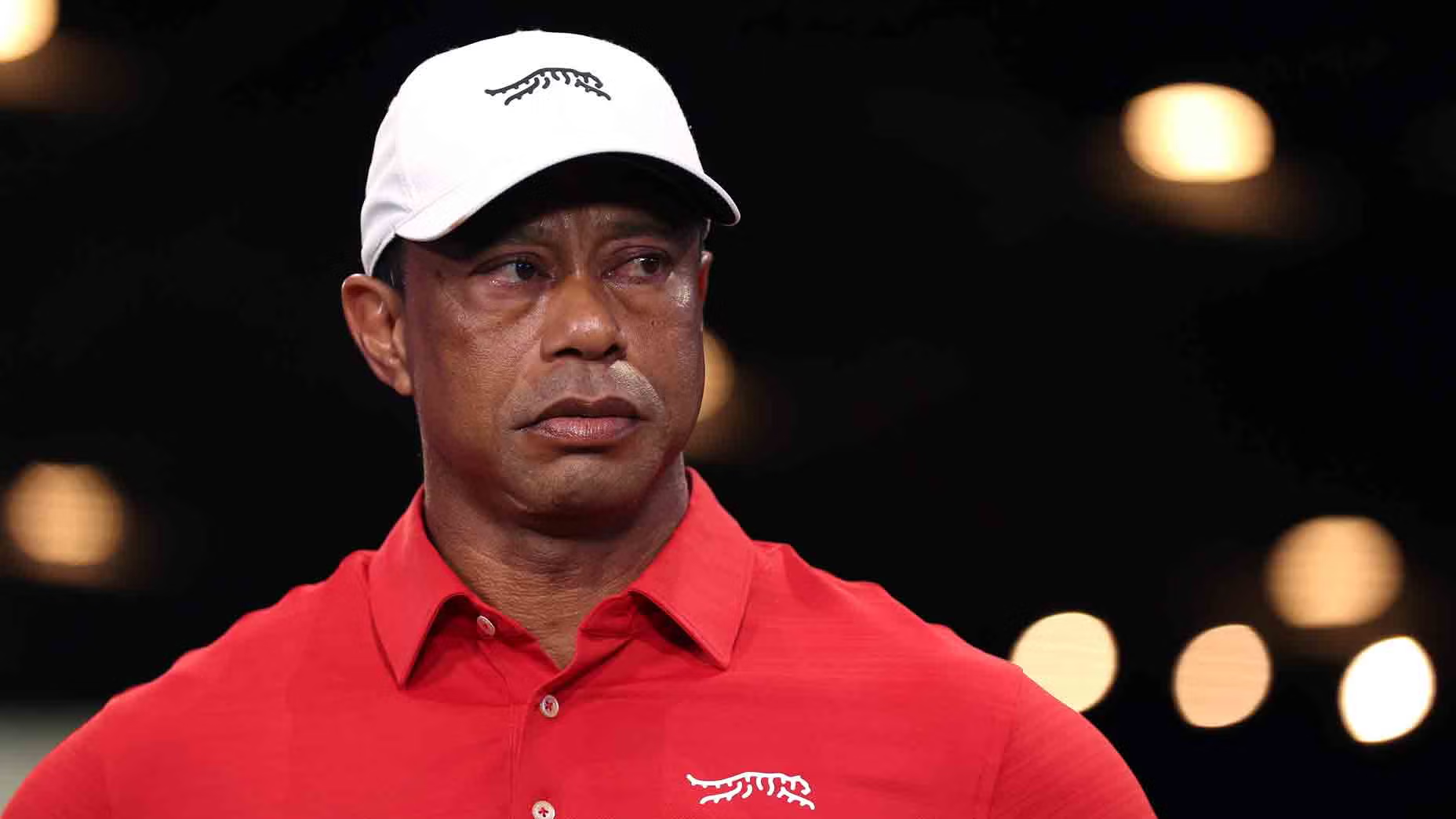
Until recently, the most pressing question around Tiger Woods was if he could play in the Masters 2026.
That changed on Friday afternoon when Woods’ Land Rover SUV flipped onto its side after tailgating a truck on a residential street in Jupiter Island, Fla. After that incident, the prospect of him competing at Augusta National looks very slim.
But another question has emerged: What legal ramifications could Woods face?
It’s the latest episode in an alarming driving story. On Friday, Woods was charged with DUI, or driving under the influence. This is the same charge he faced in 2017, when police found him asleep at the wheel of a vehicle parked in the middle of a street in Jupiter. He later pleaded guilty to reckless driving and entered a diversion program as part of his plea agreement.
Under Florida law, a DUI arrest results in immediate administrative action: license suspension, vehicle impoundment, and eight hours in jail. Woods has already served that time. He now has 10 days to seek a formal review to challenge the suspension of his license.
If convicted of a first DUI, Woods could face fines of up to $2,000, a license suspension of 180 days to a year and up to nine months in jail. The charges will qualify as misdemeanors, said David Haenel, a former Florida state attorney who now serves as a defense attorney at The Law Place, a Sarasota-based firm specializing in DUI and traffic-related cases. A felony would only apply if it was a third or fourth offense, or if the crash caused serious injury or death.
Haenel said any case brought against Woods is bound to hinge on the prosecution’s ability to prove injury. “Given his past history, I don’t think there’s going to be much denial that there was something in his system,” he said. “The question is, can they connect the dots and prove that he was impaired behind the wheel.”
Like prosecutors, defense attorneys in such cases typically work to build a factual picture: gathering evidence, searching for street camera footage, obtaining body camera footage from first responders and sending investigators to speak with other drivers involved in the crash. Eyewitness accounts, Haenel noted, can carry considerable weight. “Lay people have a lot of influence in these kinds of cases,” Haenel said. “Maybe the truck driver would say, ‘Yeah, I was talking to him before the police came and he seemed fine. He wasn’t mincing his words.’
Haenel also said something unusual about how law enforcement handled the scene. It’s highly unusual, he said, for a city police department to call a county sheriff’s department on a DUI case, since local departments are usually equipped to handle them.
“I think they probably felt they had a hot potato on their hands,” Haenel said, referring to both Woods’ celebrity and his well-publicized driving history, “so they called the circuit,” whose resources include Drug Recognition Experts, specially trained to identify impairments. If he were to represent Woods, Haenel said he would subpoena any radio or email communications between the officers.
Among the questions, he said, would be whether they knew it was Woods before making their assessment and whether that knowledge affected their conclusions. “Did they actually see evidence that he was impaired? Or did they assume he was based on what they knew of his past?” Haenel said.
Woods could also face complications from a relatively new Florida statute governing refusal of a urine test. A first refusal carries an automatic license suspension of one year and up to 11 months and 29 days in jail.
Woods’ more extensive driving history could also factor into the sentence, Haenel said. In 2009, Woods hit a fire hydrant outside his Florida home in Windermere in an incident that became a tabloid sensation. In 2021, he was seriously injured when his SUV overturned on a hilly road in Los Angeles. While neither resulted in a DUI conviction, Haenel said a prosecutor could point to that record to argue that Woods poses a continuing danger on the road and seek harsher sentences, additional traffic school and increased fines.
If the charges are reduced to careless driving, Woods will still be required to complete a Level 2 DUI program, which includes 21 hours of mandatory in-person courses. A defense attorney may request counseling or a rehabilitation program in lieu of prison.
The case will be heard in Martin County, which Haenel described as known for aggressively prosecuting DUI cases. As for how he expects the case to play out, Haenel said it will come down to the evidence. “If the prosecutor has an evidentiary problem, they can go with reckless driving,” Haenel said. “If they think they can prove it, they’re going to try to make it into a DUI.”
However, it is unlikely that this question will be resolved soon. Cases of this type typically take six to nine months to resolve, Haenel said.

