


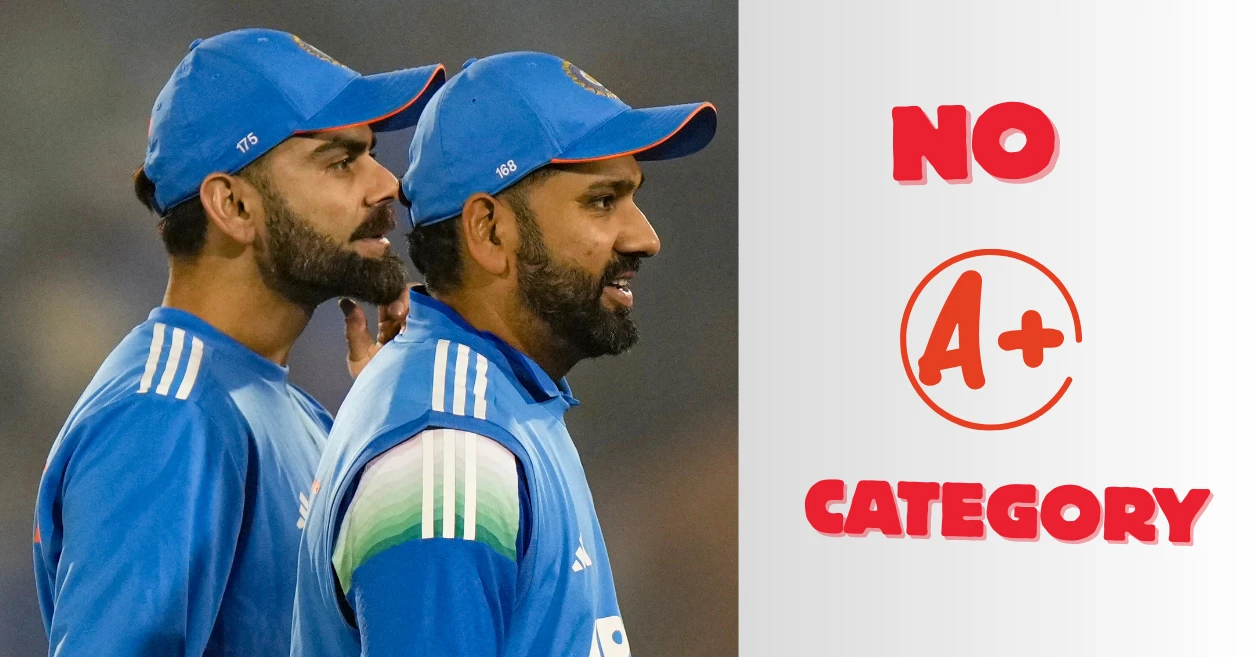

The Board of Control for Cricket in India (BCCI) A major overhaul of the annual central contract system is set to take place in a move that could change the classification and compensation of India’s biggest cricket stars. The board is reportedly considering scrapping the elite A+ bracket altogether, a change that will directly affect senior players. Virat Kohli and Rohit Sharma.
If the proposal is approved, both Kohli and Rohit are expected to be placed in Grade B under the new structure, which reflects their current status as active players in only one international format.
Proposed restructuring of BCCI central contract
The proposed restructuring was recommended by the national selection committee headed by Ajit Agarkar. A final decision is expected to be taken after deliberations at the upcoming apex council meeting, where the BCCI will also unveil a revised financial framework that will govern the new contract system.
Currently, central contracts are divided into four tiers – A+, A, B and C – which operate independently of match fees. The current system values A+ grade at ₹7 crore, A grade at ₹5 crore, B grade at ₹3 crore and C grade at ₹1 crore.
Why is Category A+ Deletion Scheduled?
Under the new proposal, the A+ category will be scrapped entirely, leaving only three tiers: A, B and C. While the revised salary structure has yet to be officially announced, the most notable change will be the elimination of the A+ tier, a reward for players who contribute in all three formats.
In the 2024-25 central contract list released in April 2025, Kohli and Rohit were part of the A+ bracket. Ravindra Jadeja and jasprit bumrah. However, with Kohli and Rohit now focusing only on ODIs, they do not meet the eligibility criteria set for the higher level.
BCCI secretary Devajit Saikia made clear the rationale behind the proposed changes, stressing that the decision was purely based on cricketing considerations and not financial disputes or personal differences.
“The plan will come to fruition soon. We are removing a category because players who qualify for the A-plus category now play only one of the three formats. The criteria we have set to qualify a player for A-plus is not met,” Saikia told Sportstar.
He further clarified that the amendment should not be taken as a downgrade or a sign of a rift between the players and the board.
Saikia reiterated that the changes reflected the evolving nature of international cricket and player workloads, stressing that there was no tension between the BCCI and its senior stars.
“Some of the players in that A+ bracket decided not to play in all three formats. So there weren’t enough players left to qualify and meet the eligibility criteria. One format player wouldn’t be eligible for A+, so we had to make the call. No heartburn,” he explained.
Also READ: Virat Kohli’s Instagram goldmines – How the social media king turns his posts into millions?
A move to encourage excellence in all formats among young players
One of the main objectives behind streamlining the contract structure is to incentivize players who perform consistently across Tests, ODIs and T20Is. By simplifying the categories, the BCCI hopes to ensure that cricketers who manage the toughest international schedules receive the highest financial rewards.
The revamped system is also expected to encourage young players to establish themselves in all three formats, aligning rewards to workload and availability rather than reputation alone.

