


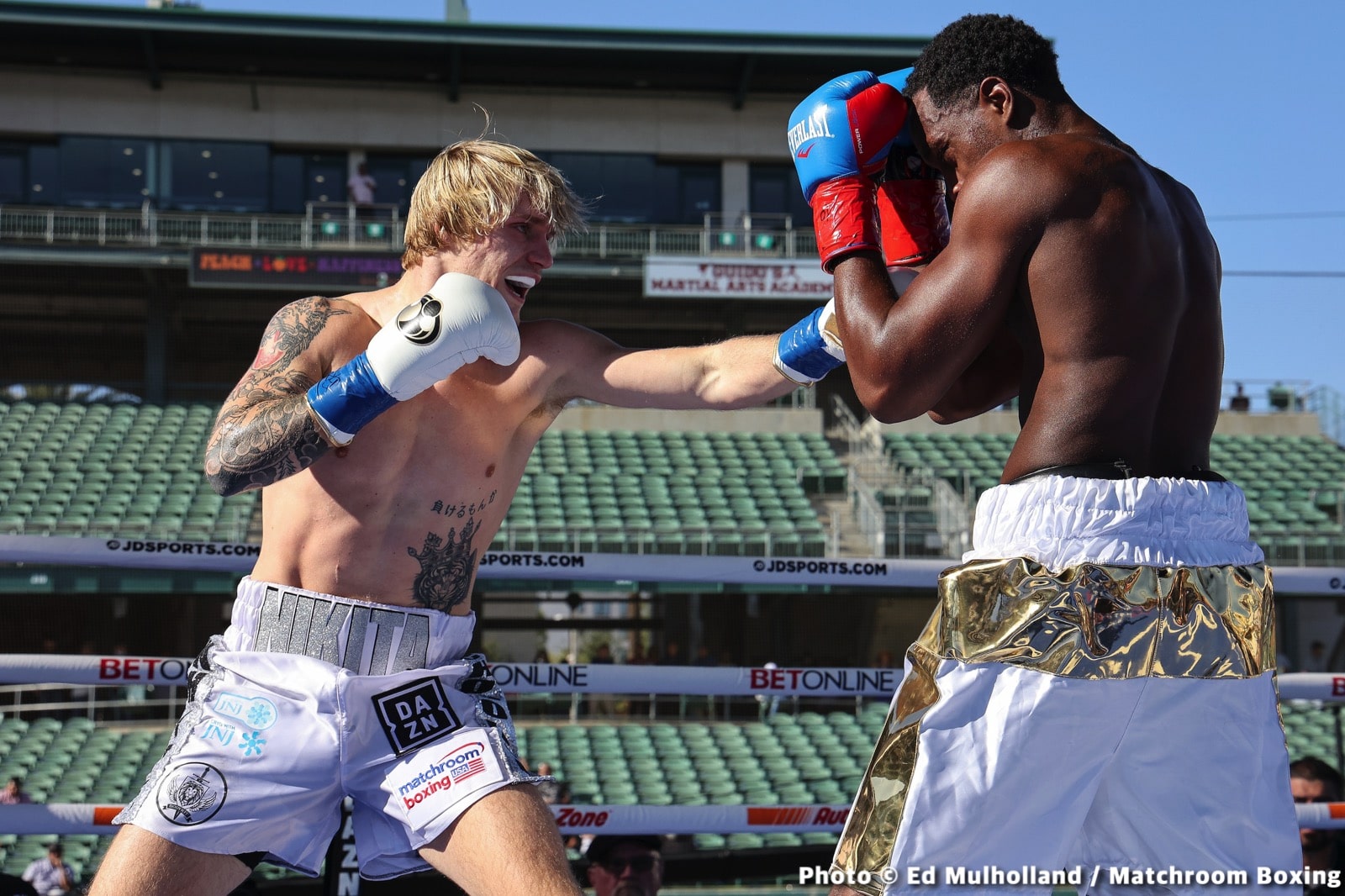


Q: How did you get into the boxing gym? How old were you when you had your first sanctioned match?
A: I grew up in Brighton Beach, and boxing was just always there. My dad took me to the gym when I was a little kid because I had too much energy and needed some discipline. Once I put the gloves on, I never wanted to take them off. I had my first sanctioned fight when I was about 10 years old, and from that moment I knew this was what I wanted to do with my life.
Q: You had more than 130 amateur fights and won the New York Golden Gloves in the 152 lb. open division won. You turned professional at 17 instead of fighting in the Olympics. Did you feel you were better suited to professional boxing?
A: Yes, definitely. The amateurs were great for experience, but my style was always more suited to the professional ranks. I like to sit on my punches, go to the body, break guys down. In the amateurs you can point people out and move around, but I’ve always wanted to hurt guys and put on a show. Turning pro at 19 just felt like the right move for me.
Q: As just a young kid, you chatted with the likes of fellow Brooklynite and former middleweight champion Danny Jacobs. Any other notable names you’ve shared the ring with while ghosting or fighting in the amateurs?
A: Sparring with Danny Jacobs was huge for me early on. This is a world champion and a great guy who gave me serious work. I also shared rounds with a lot of top guys coming through New York gyms, pros and amateurs. When you’re in the Brooklyn gym scene, you’re always close to killers, so every sparring session feels like a real fight.
Q: Brooklyn amateur standouts you’ve fought alongside — like WBC featherweight champion Bruce “Shu Shu” Carrington and IBF super lightweight champion Richardson Hitchins — are making headlines these days. How frustrating was it to sit on the sidelines watching your neighbors grab title belts?
A: Look, of course you want to be in that spotlight too. These are my guys, and I’m proud of them, but at the same time, I know I belong right there with them. Boxing is a crazy business, and sometimes things outside the ring slow you down. But believe me, the hunger only gets stronger when you watch everyone else shine. My time is coming.
Q: For those who haven’t seen you fight, who would you liken or compare your style to any boxers past or present?
A: I think I bring a little old school flavor. I love body punching like the greats used to do. Some people say I remind them of Roy Jones Jr. with the way I attack the body, and I’ll take that as a huge compliment. But honestly, I’m just trying to create my own style — that “White Chocolate” style.
Q: You seem to have a genuine love for the sport of boxing, despite boxing your own shadow for over two decades. Would “No Boxing, No Life” be an accurate description of how you feel about the sport?
A: That’s exactly how I feel. Boxing gave me everything – discipline, purpose and a way to express myself. When I’m not working out, I’m thinking about training. When I’m not fighting, I’m thinking about fighting. For me it’s not just a sport, it’s a lifestyle.
Q: Did you ever work a regular job, or was boxing your only occupation?
A: Boxing has always been my main focus. Ever since I was a kid, it was gym, school, gym again. When you start fighting young and chasing big dreams, you structure your whole life around that. I’ve always treated it like a full-time job.
Q: What do you do with your time outside the ring?
A: I like to keep things simple. Spend time with family, hang out with friends, maybe watch fights and study the game. I’m also big on recovery – stretching, sauna, things like that. And of course I love being around the ocean when I’m in Florida.
Q: What is currently in heavy rotation on your music playlist when you work out in the gym?
A: It’s a mix. I would say it’s mostly hip-hop and house music.
Q: You’re leaving snowy Brooklyn for the sunny borders of South Florida to train at BOXR Gym, where light heavyweight champion David Benavidez will train for his fight against Zurdo Ramirez. How do you like life in the 305?
A: I love it. The weather is amazing, the atmosphere is different, and there are a lot of serious fighters down there. Being around guys like David Benavidez and other hungry champions at BOXR Gym pushes you to another level. It’s all about the upside.
Q: A video recently surfaced of you dropping a tough decision to a very good Russian fighter named Yuri Osipov. At first I thought it was a professional fight because there was no headgear, but it was actually a five-round exhibition. What happened that night, and what did you learn from that fight?
A: This fight remains one of the most challenging experiences of my career. I didn’t have to take it since it was just an exhibition game, but I agreed to it under difficult circumstances. I arrived in Russia at short notice four days before the fight and fell seriously ill. Even my trainer, Andre Rozier, who was traveling with me, passed out in front of everyone during the weigh-in due to the same stressful conditions.
Because of my illness and the weight required to fight, I was unable to properly hydrate, take medication, or maintain adequate nutrition. Despite my team advising me to withdraw, I chose to compete because of the financial incentive. In retrospect, that decision was unwise.
Although the match does not count on my professional record, it was a valuable learning experience. If I ever take an exhibition again, I will make sure that I am properly prepared and put my health first.
Q: You recently started training at BOXR Gym with legendary New York trainer Milton LaCroix. Any new wrinkles in your game that you’ve worked on with Milton?
A: Milton is a mastermind. We worked on sharpening everything – defense, angles, setting up my body shots even better. The power has always been there, but now it’s about being smarter and more complete in the ring.
Q: These days, many fighters seem content to participate in a snoozefest to get a safe win and a paycheck, losing sight of the fact that this is an entertainment business. When you fight, being an entertainer seems to be part of the “White Chocolate” experience. How important is it to you to put on a show for the fans rather than getting an easy W?
A: It’s big. Fans spend their hard earned money to watch us fight. They deserve excitement. I want people on the edge of their seats every time I step into the ring. Knockouts and body blows — that’s what boxing is all about. When you watch White Chocolate, you know you’re in for a show.
Q: You have a huge following among the Russian fans in Brighton Beach. What does it mean to you to represent your hometown when you step into the ring?
A: It means everything. Brighton Beach raised me. That community supported me from the beginning. When I fight, I feel like I’m carrying all of Brooklyn and all those fans with me. That pride drives me to perform at my best.
Q: Even though you’re migrating south to train in Florida, Brooklyn is where your heart is. Anything you want to say to Brooklyn fans — or anyone in particular you want to shout out to shake hands with?
A: Brooklyn, I appreciate all the love. Don’t worry, I’m working, and I’m coming back stronger than ever. And to anyone in the middleweight division who thinks they are safe… keep my name in mind. White chocolate is coming, and if I get my shot, I’ll take the belt back to Brooklyn!

