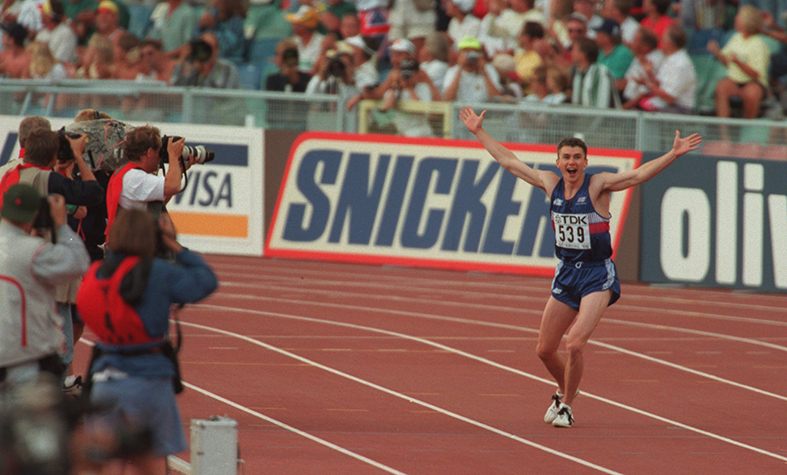
Editor’s Note: The triple jump in Torun should be a lot of fun. The jump that Jonathan Edwards made thirty-one years ago was historic, and I thought that as we prepare for the Torun 2026 event, it might be fun to think about how a World Record, or series of World Records and World Performances, changes a person’s career and life.
Originally published on RunBlogRun on August 21, 2015 for the 20th anniversary. This piece was updated for the 30th anniversary in August 2025.
Jonathan Edwards 30 years later
More than 30 years have passed since Jonathan Edwards jumped, stepped and jumped 18.29 meters to set a world record at the 1995 World Championships in Gothenburg, Sweden. The record he broke was his own 18.16 meters, which he had set twenty minutes earlier. He also recorded 18.43m with an illegal (2.4) wind in another event. To put that into context, Jordan Diaz won the 2024 Olympics with 17.86m and Hugo Fabrice Zango won the 2023 World Championships with 17.64m. The USA Champs this year won with a distance of 17.15m, while the winning distance for the 2025 GB Champs in Jonathan’s home country was 15.79m.
Christian Taylor (18.21m) is one of eight athletes since Edwards to break 18m, with Jordan Diaz the only one to do so in the past five years, that is, since Edwards accomplished the feat twice in 20 minutes. Christian looked like he could become the man who could break the world record, but once he explained to me why it was so difficult. “I can’t stress enough how much I respect distance. The reason for standing so long is that it is a phenomenal distance. I can’t talk about that without talking about the respect and distance I have for the man.”
Jonathan’s own take on why the record took so long is: “The talent pool in field events has just gone through and I don’t think athletics has kept pace with the professionalization and commercialization of other sports. You can go elsewhere for better rewards and probably a better experience in terms of coaching, social environment and camaraderie.” (The Sunday Times, 9 August 2025).

“I was running faster, I was stronger, I improved my technique, but it still didn’t match what happened. Obviously, I didn’t know my potential, so it was still a big surprise for me. I look back and shake my head. Another thing to deal with was going through the 18m. 17-point whatever 35 years. So you have a whole tape playing in your mind. That’s what triple jumpers do. They jump 17 meters. Then it goes to 18 meters. There’s a whole paradigm shift to get used to when watching the event. That doesn’t help either. It’s totally unbelievable. And all the various awards that go with it. I just crossed the line of what I ever dreamed was possible.”
What Edwards got at was well summed up in a reader’s comment in response to a newspaper article this month: “Those jumps in Gothenburg were phenomenal. I remember watching them on TV. Edwards was poetry in motion, absolute perfection. The triple jump has never been more exciting. You felt like he was going to break the world record every time he singled and kept running. (James Varley, The Times, 10 August 2025).
Not that his career has always been smooth sailing. He was 23 years oldth 1988 Olympic Games and 35th in 1992 (not making it to the final in any of them). He went into the 1996 Olympics as the clear favorite and finished second. He was world champion in 1995 and 2001, but not in 1993, 1997, 1999 or 2003. Going back to the 1992 Olympics, Jonathan told me at the time: I didn’t even get to 16m despite jumping 17m reasonably consistently throughout the season. It was probably the worst period of my life athletically. I was absolutely devastated.”

I knew Jonathan when he was competing and had a few conversations with him. He was always a thoughtful athlete and also one who asked himself many questions about how he lived his life. Before becoming a major athlete, he worked in a hospital laboratory. He sometimes struggled with giving up a “valuable” profession for something trivial. “You fly into a sand pit, they measure you, and suddenly you’re famous,” I heard him say. Again, he thought it was funny to tell people.
At the same time, he realized that it was special. “I am in a very unusual position. Very few people in any walk of life can say they are the best, clearly the best, indisputably the best, at something, even if what you’re the best at is pretty minor, it’s there for all to see.”
Another critical aspect of Jonathan’s complex story concerns faith. He had a strong Christian faith when he was an athlete, and for several years he did not compete on Sundays. He later changed his mind and participated on Sundays, but still struggled with what it meant to be a Christian athlete. He spoke of how selfishness is required to compete at the highest level, being “the antithesis of the Christian life of self-sacrifice and giving.” However, he was convinced that being an athlete was what God intended for him. He took a sardine to the 2000 Olympics as a reminder that just as Jesus used five loaves of bread and two small fish to feed 5,000 people, Jesus could use Jonathan’s ability in the triple jump for God’s glory.
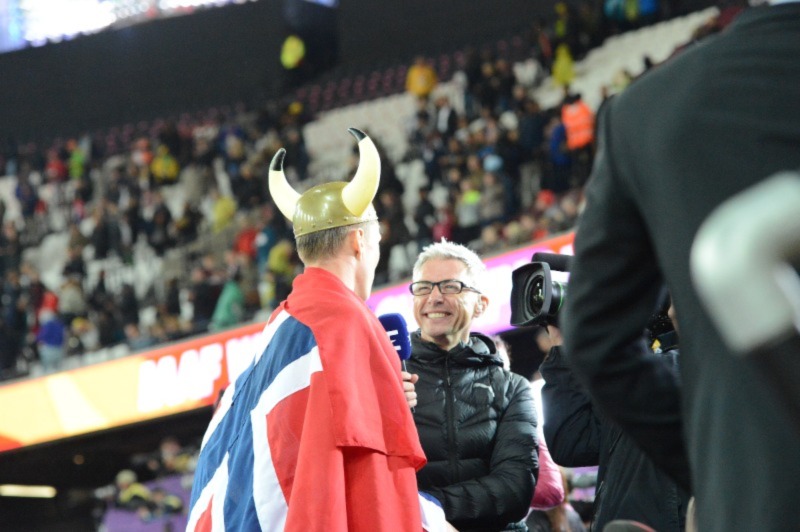
After retiring in 2003, he began to question his faith, describing himself in an interview as “probably agnostic but practically an atheist”. He elaborated. “When you think about it rationally, it seems incredibly improbable that there is a God,” adding that his view is that everyone is actually agnostic because no one can be sure. He said that after rejecting his childhood beliefs, he “feels happier inside than at any time in my life.” At the same time, he admitted that his success as an athlete is fundamentally connected to his Christian faith. (The Times27 June 2007)
Only after retirement was he able to separate faith and sport. “My faith and athletics have always been very intertwined, and when I retired it gave me the freedom to ask questions. My horizons expanded. I didn’t just have this group around family, friends and church in Newcastle.
Whatever you think of his faith, or lack thereof, Jonathan Edwards is the greatest triple jumper who ever lived. His world record has stood for 30 years and shows no signs of breaking anytime soon.