


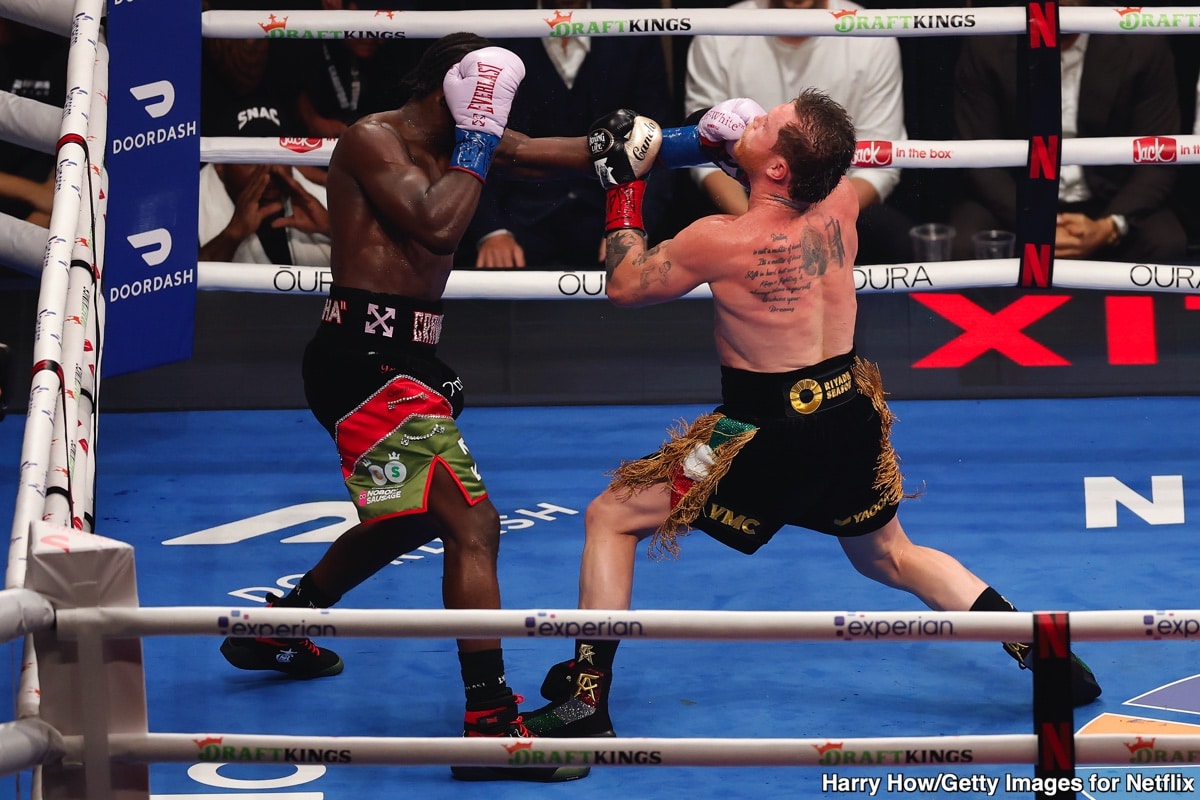


Crawford pointed to Canelo Alvarez vs. Edgar Berlanga as the moment he made that call.
“When I was at 147, I already called out Canelo. I already said I would move up three weight classes and fight Canelo,” Crawford told Jai McAllister. “Me and Turki went to see him fight Berlanga, and I said: ‘He can’t beat me.’
Berlanga entered as a heavy underdog and lacked the movement or output usually needed to trouble Canelo. Still, Canelo couldn’t break him down quickly, working in short bursts rather than sustained pressure.
Crawford saw this as a sign of something deeper. From 2021 to 2025, Canelo Alvarez held all four titles at 168, but hasn’t consistently faced the most dangerous threats in the division.
Younger fighters like Osleys Iglesias, Christian Mbilli and Diego Pacheco represented a different type of challenge, built on volume, physicality and pace.
Instead, Canelo’s run included an older Gennadiy Golovkin, John Ryder and Berlanga, opponents who didn’t force him into extended exchanges or test his ability to handle sustained movement.
Crawford made a call that those habits would carry into their fight. When they met in September 2025, he controlled distance, stepped around exchanges and prevented Canelo from setting his feet.
Canelo was reduced to singles, while Crawford set the pace over long stretches, leading to a unanimous decision victory and all four super middleweight titles changing hands.
Crawford didn’t just believe he could win. He read a pattern, trusted it would hold, and proved it against a different level of opponent.

