
Updated on March 11, 2026. This is the warm-up and cool-down document for distance runners written by Roy Stevenson.
We’ve provided some suggestions for sprinters, jumpers, throwers, and now distance runners during their warm-ups and cool-downs.
Warm-up and cool-down for remote events
By Roy Stevenson

Distance runners need a solid warm-up to prepare physically and psychologically for their races and training. Benefits of a warm-up include increased oxygen concentration in hemoglobin and increased oxygen and blood flow to working muscles. In addition, warming up dilates the alveoli in our lungs, increases our heart rate, and facilitates a biochemical cascade in our muscles that enables us to tolerate more lactate and burn more free fatty acids for fuel.

And if timed right, the warm-up engages our neuromuscular, skeletal, cardiovascular and respiratory systems, giving us our “second wind.” Just as importantly, warming up helps nervous young athletes stabilize their adrenaline rush, helping them control their nervousness before a race.
Research shows that for high school distance events (800m, 1600m, 2 miles), warming up improves performance; but the intensity should be above 40% of VO2 max. Research also shows that if we wait more than 10 minutes between the warm-up and the start of the race, we lose some of its benefits.

Distance runners should start their warm-up about 30 minutes before their event or training session. Stage one a distance warm-up begins with 10-15 minutes of slow jogging to increase body temperature, increase muscle elasticity, and decrease blood viscosity.
Stage two immediately follows the first stage. A 10-minute stretching session that begins with static stretches and progresses through dynamic and ballistic stretching through a full range of motion, such as leg swings. Distance runners should focus on calf, hamstring and quadriceps first, then hamstrings and groin, with some upper body stretches. Go from static to dynamic stretching as fast as you can – research shows that static stretching can actually decrease the strength and power of muscle contractions, not a condition we want our runners to start their training or race with.

Here is a warning to the coaches. The stretching phase of the warm-up often lasts too long, negating the effect of the previous warm-up, so keep it short, sharp and sweet.

Once the runner is generally “set up,” it’s time for the third phase of the warm-up, which consists of specific exercises that put the finishing touches on the warm-up. These usually include leg speed exercises, and this is where race and pre-training warm-ups differ. A pre-race warm-up requires a few (3-6) easy “speed steps” over 50 meters, but no longer than this. This phase should be completed 5 minutes before the start of the race and until then the runner should only do a walk/jog to warm up.
If the warm-up precedes the workout, the runner can go through a series of 5-10 x 100 meters of “acceleration stride” where he focuses on proper running technique and stays calm while maintaining a quick foot turn. These should be done with rolling starts where the runner gradually increases his pace after running slowly for the first 10 meters. Each step should be slightly faster than the previous one, and the last step should be at about 95% of maximum speed.
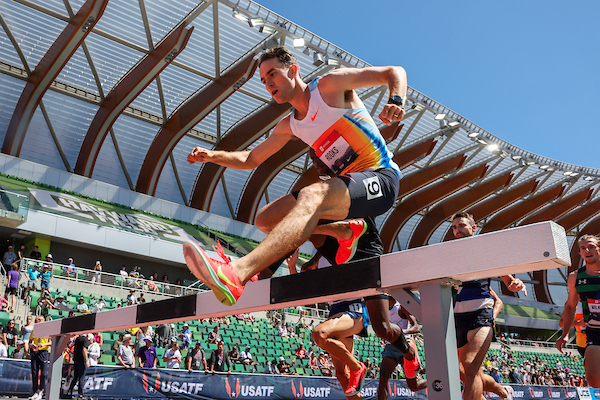
Eugene, Oregon, USA
July 31 – August 3, 2025 Photo by Kevin Morris
After this faster effort, many coaches give their runners a variety of exercises, ranging from sidesteps or jogs (aka carioca), running backs, quick leg turns on stairs and other ladder exercises, cone runs for agility, short knee raises (walking or jogging), heel walking, 2 exercise, meters, plyometrics, calisthenics such as squat thrusts, short sprint up, sprint down, etc., you get the idea. There are entire books devoted to these exercises. You don’t have to do all of these exercises in every warm-up, just do a few different exercises in each warm-up to keep it interesting and fun.

After that, some coaches integrate a longer interval in the third phase, which usually consists of 600 meters to 1,200 meters per repetition at around 75% to 85% of the athlete’s current best time for 800 meters.
Having completed these three phases, the distance runner is now ready for his main training. A teenage distance runner’s total warm-up time should not exceed 35 minutes or a total of 3 miles, whichever is longer.

risk of tiring, overheating and dehydrating the runner and depleting his glycogen stores.
The key to a good warm-up is to make sure your distance runners are ready to race without these side effects. Another warning. in hot or humid conditions, make sure your runners hydrate with water or a diluted electrolyte drink during the warm-up. They should avoid sugary soft drinks because of the risk of a sugar spike followed by the inevitable blood sugar crash; and they can also make a runner feel sick during a race.
Other things to note about heating
If the temperature is very cold, passive rewarming, where external heating agents such as hot tubs, hot water bottles, and hot showers are applied, can be very effective before going outside for active rewarming.
The cool down consists of a short warm up. i.e. an easy 5-10 minute run followed by static stretching should not be neglected.