


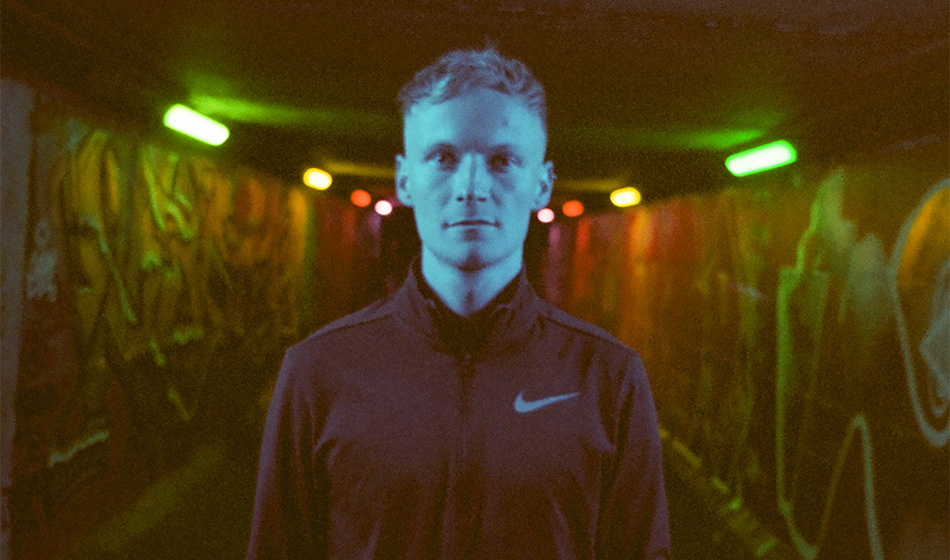
A new documentary and passion project aims to showcase the ups and downs and skill of being a race walker.
It didn’t start with a commissioning editor or a funding offer,” says Tom Ruddock. “It started with my dad. Len Ruddock, Ilford AC member, former training partner of European Games bronze medalist Roger Mills, has lived and breathed race walking for as long as I can remember.”
The filmmaker discusses his new project, The Art of Walking, a documentary that brings the triumphs, struggles and hard work of two-time Olympian Callum Wilkinson into sharp focus. It recently premiered on Athletics Weekly’s YouTube channel, a fitting collaboration for several reasons.
“As a teenager, having a race-walking father wasn’t exactly a social value,” Ruddock continues. “But what stuck with me was the discipline, the quiet tenacity, the kind of commitment only special sports seem to require.
“My dad has always been one of my biggest supporters and I’ve been wanting to collaborate with him on something meaningful for a long time, so when he started his YouTube channel, Race Walking Extra, and mentioned he was in touch with Callum, it seemed like an opportunity.
“Then he sent me AW: interview with Callumwhere he described race walking as an art form. He spoke candidly about the efforts it took to reach Paris 2024. I watched the video of the British Championship qualifying for the Olympics. The feeling. The relief. The years condensed into an instant. I immediately knew this was a movie.”
Manchester’s national record-breaking performance from almost two summers ago is on film, as is Wilkinson’s release of pure emotion at the finish line, which becomes more understandable the more you learn about the circumstances in which it was achieved.
That 10,000m race was set up to give the now 28-year-old what he needed to qualify for Paris. “It was the last day of the qualifying window, the last chance,” says Wilkinson.
He took it, and his long injury struggles, surgeries, and monotonous hours of rehab became a thing of the past. Given the sport’s ongoing struggle to maintain its place on the athletics table, it takes a lot of character to simply be a racer, but even more so to compete at the highest level.
“Once you qualify for the Olympics and you can call yourself an Olympian, you have it for life,” Wilkinson says. “No one can take that away from you. To do this the second time you could have left the sport or had it taken away from you and you were able to keep that childhood dream alive and get back to a place where you could really enjoy it;
“As much as I was 10th in Tokyo (in 2021) and 16th in Paris, it was almost certainly a better performance to get there and come back. It was so much more for me than I ever thought possible.”
However, the emotional challenges of being a competitor and the comeback story were only part of what Ruddock wanted to capture on film. He also had other things on his mind. Within minutes of first talking to Wilkinson about the project, he says: “I felt the clarity, flexibility, depth of the performance.”
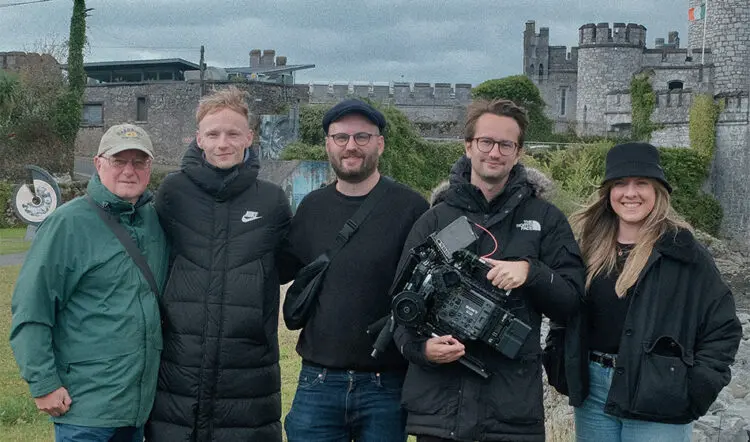
Soon after, he, producer Shelly Ruddock, cinematographer Yannick Hausler and Len Ruddock flew to Wilkinson Training Base in Cork for a 48-hour shoot.
“The goal was clear. to treat racing as an art,” says Tom. “Don’t just document it, film it. Draw the rhythm of the hips, the accuracy of the contact of the legs, the economy of movement. We shot segments on 16mm film to add texture and grit to the training sequences.
“There’s something about the grain of film that respects repetition and hard work. That seemed right for a discipline based on both. What we weren’t quite ready for was the speed.
“I have filmed runners before. Yannick and I had just come off a TV drama that involved a whole chase sequence, but shooting an Olympic race walker is different. The cadence is relentless. Even at a ‘steady pace’, Calum was moving faster than expected and we were a crew of four.
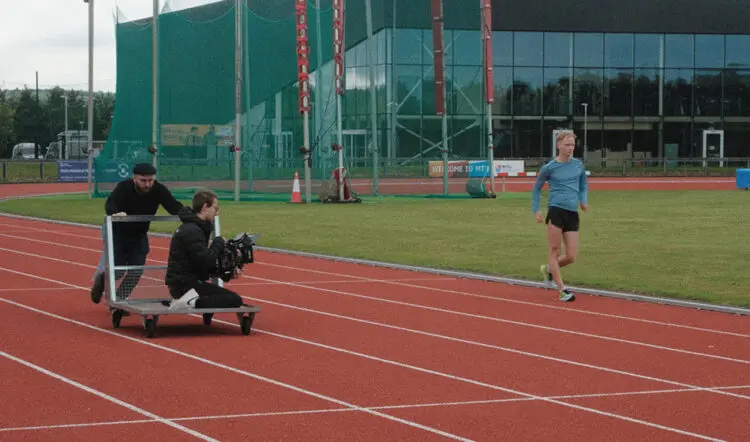
“At one point, near the university track, we found a trolley and that led to me sprinting, pushing Yannick, camera in hand, trying to match Callum’s pace. Later, in the gym parking lot, we shot from the back of the rental car. Unusual solutions, but necessary. If the audience feels the speed, we will understand.
we did our job.”
Wilkinson hopes that speed can carry him through to another Olympics, where he aims to be a medal contender. That goal is not made any easier by the fact that he is no longer funded by the World Class Program.
“Racers train like marathoners, but without the same infrastructure or sponsorship security,” Ruddock says. “Callum’s story is one of persistence, not just physically but financially and emotionally, and it’s ongoing.
“As he builds Los Angeles 2028, we hope that this short documentary is only the beginning of a full-length feature film. it helps support the next chapter to follow and shines a light on a sport that is thriving globally but struggling for visibility in the UK.
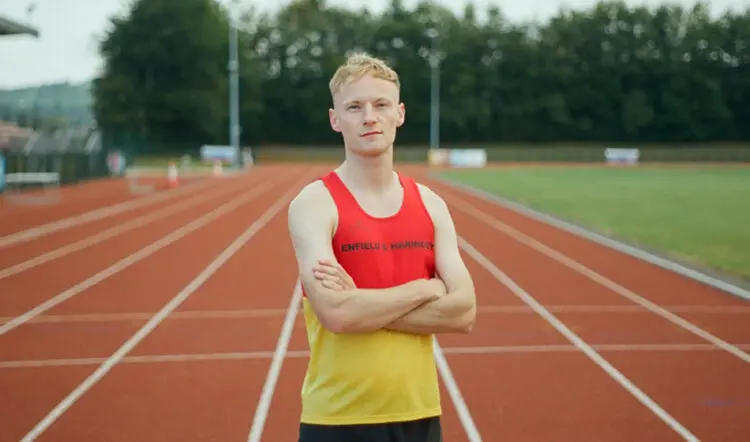
“Race walking is often misunderstood, but when you look closely, really look, there is beauty in limitations. Accuracy of the rules. Art in repetition. As Calum says at the beginning of the film.
There is also that very personal connection for the person leading the project.
“My father has five decades of shelves Athletics Weekly magazines, so premiering this film here in the pages and on the platform he’s been revered for so long feels like a full-circle moment,” says Ruddock. “From Ilford AC to the Olympics. From father to son. This is where The Art of Walking really began.
The Art of Walking by View 35 Films is out now. Watch here

