


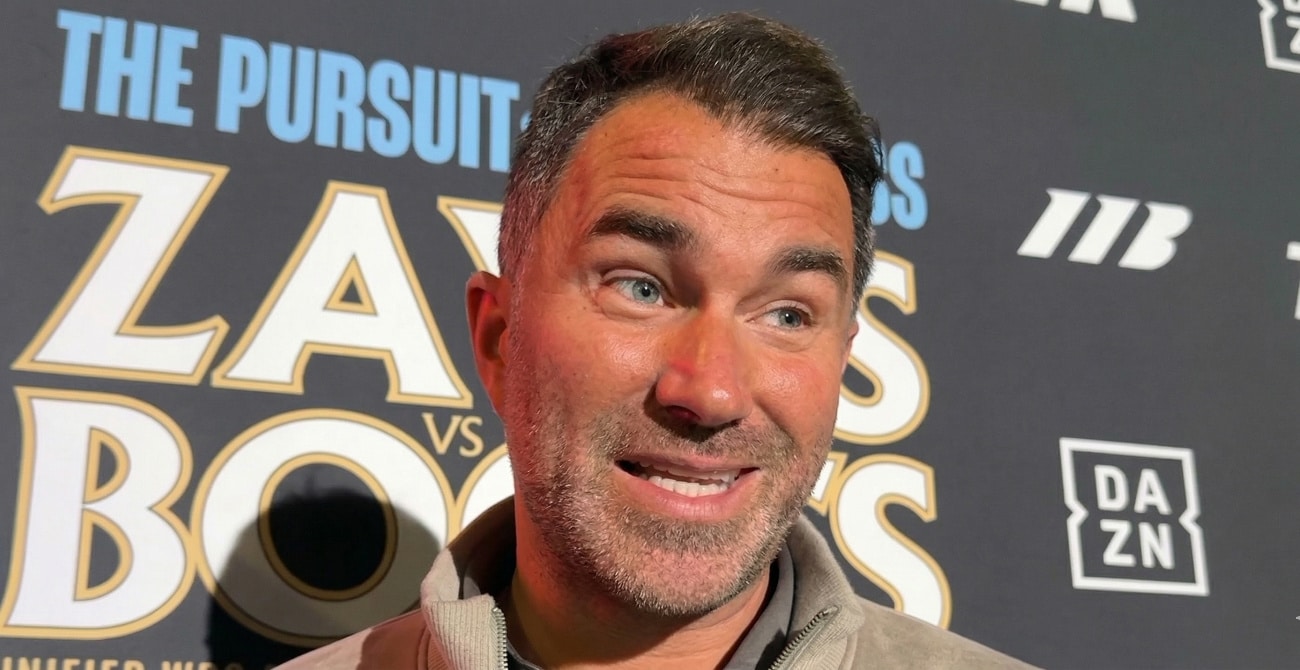


Hearn made a clear distinction between the two. According to him, Berlanga chose a money lane that matched his ceiling, while Hitchins got there after running out of alternatives.
On Berlanga, Hearn was blunt about both the opportunity and the limitation.
“I don’t think he’s necessarily going to win world championships, but financially it’s a good opportunity for him,” Hearn told Fight Hub TV.
Berlanga, 28, has essentially become a high-level gatekeeper or a special attraction fighter. He can still make good money, but the days of unearned shots at the undisputed king for eight-figure checks are probably over. He is at a total career recovery point.
The stats from that Sheeraz fight are brutal. Berlanga was dropped three times before being knocked out in the fifth fight last July. When you lose back-to-back high-profile fights to Canelo and then Sheeraz and get stopped in the second one, that undefeated power puncher marketing strategy is dead and buried.
Traditional promoters like Matchroom or Top Rank are unlikely to touch Berlanga at his previous price as he has proven that he cannot beat the top tier at 168.
“He’s not going to beat the top guys at 168. Come on,” Hearn said of Berlanga.
Hearn’s comment is the boxing version of “saying the silent part out loud.” It’s a brutal reality check, but when you look at the scene in the 168-pound division, it’s hard to argue that he’s wrong.
By saying “Come on,” Hearn is basically rejecting the marketing hype he himself helped build when trying to sell the Canelo fight. It shows that even the people who promoted Berlanga did not actually believe that he belonged to the elite.
Hearn revealed a situation where options disappeared one by one for Hitchins. Matchroom has withdrawn. Other promoters showed little interest. The negotiating stance taken before his last fight didn’t help matters.
“We withdrew our offer. Top ranking wasn’t an option, and Golden Boy wasn’t really an option,” Hearn said.
“They tried to be smart, then we were done,” said of Team Hitchins.
By saying “We’ve withdrawn our offer,” Hearn signaled that he didn’t even want to go back and forth. He felt the gap between what Hitchins wanted and what he was worth was too wide to bridge.
When Top Rank and Golden Boy also passed, it proved Hearn’s point. If the biggest players in the game aren’t bidding for you, you’re a misfit.
Hearn basically calls out Richardson Hitchins and his team for fumbling the bag. In boxing circles, “trying to be smart” is promoter-speak for a fighter who overestimates their market value and asks for money or terms that don’t justify their ticket-selling power.
“If you care about your legacy and you want to be great, don’t take it,” Hearn said.
Hearn’s comments are a direct shot at the Zuffa Boxing business model and what it means for a fighter’s autonomy. In the traditional world of boxing, “greatness” is often measured by a fighter’s ability to navigate the rankings, pick up belts from the four major sanctioning bodies (WBC, WBA, IBF, WBO) and ultimately go uncontested.
By saying “don’t take it,” Hearn argues that signing with Zuffa effectively trades your “legacy” for a “paycheck” in a closed system.


