


Each World Cup final offers pressure, prestige and a global audience. But only a handful become legends. Some are remembered for the football, others for the controversy, and others for the drama that unfolded over 90 minutes (or much, much more). Here’s our ranking of the best World Cup finals ever played, judged by the stakes, the quality and how often we’re still talking about them today.
- 1. Argentina 3-3 France, Lusail, 2022
- 2. Brazil 4-1 Italy, Mexico City, 1970
- 3. England 4-2 West Germany, Wembley, 1966
- 4. West Germany 3-2 Hungary, Bern, 1954
- 5. Uruguay 2-1 Brazil, Maracanã, 1950
- 6. Italy 1-1 France, Berlin, 2006
- 7. West Germany 1-0 Argentina, Rome, 1990
- Honorable Mentions
- What makes a great finale?
- How the finals have changed
- Where to look back at it all
- conclusion
1. Argentina 3-3 France, Lusail, 2022
It had everything. Lionel Messi vs Kylian Mbappé. A 2-0 that became 2-2 in 97 seconds. Goals in extra time, a second tie, a penalty shootout. Mbappé became the first man to score a hat-trick in a final since 1966, and still lost. For Messi, it was the missing crown of a career that many already considered the greatest of all time. No final has packed more history into a single match.
2. Brazil 4-1 Italy, Mexico City, 1970
Tactically, technically, aesthetically, the gold standard. Carlos Alberto’s fourth goal, the culmination of a fluid team play, remains the most repeated sequence in World Cup history. This was football as art, in front of 107,000 fans inside the Azteca, with Pelé in his prime. The result confirmed Brazil’s third title and the withdrawal of the original Jules Rimet Trophy from circulation.
3. England 4-2 West Germany, Wembley, 1966
The only World Cup England have ever won, and the source of almost six decades of ‘is the ball over the line?’ debate Geoff Hurst’s hat-trick, including a goal off the crossbar that still divides opinion, sealed a 4-2 extra-time victory. He also gave us one of the most famous lines in sports: “They think it’s over… now it is.”
4. West Germany 3-2 Hungary, Bern, 1954
Known as the “Miracle of Bern”. Hungary’s Mighty Magyars were unbeaten in more than four years, beating West Germany 8-3 in the group stage and taking a 2-0 lead eight minutes into the final. Then it rained, the German Adidas cleats caught and Helmut Rahn hit the winner. A nation rebuilding from World War II found a symbol of a new identity in a single afternoon.
5. Uruguay 2-1 Brazil, Maracanã, 1950
Technically the deciding match of a final group rather than a knockout final, but treated as a final by both FIFA and history. 200,000 Brazilians inside the Maracanã were waiting for a coronation. The Uruguayan Alcides Ghiggia silenced them. “Only three people have silenced the Maracanã,” he said later. “Frank Sinatra, The Pope and Me.”
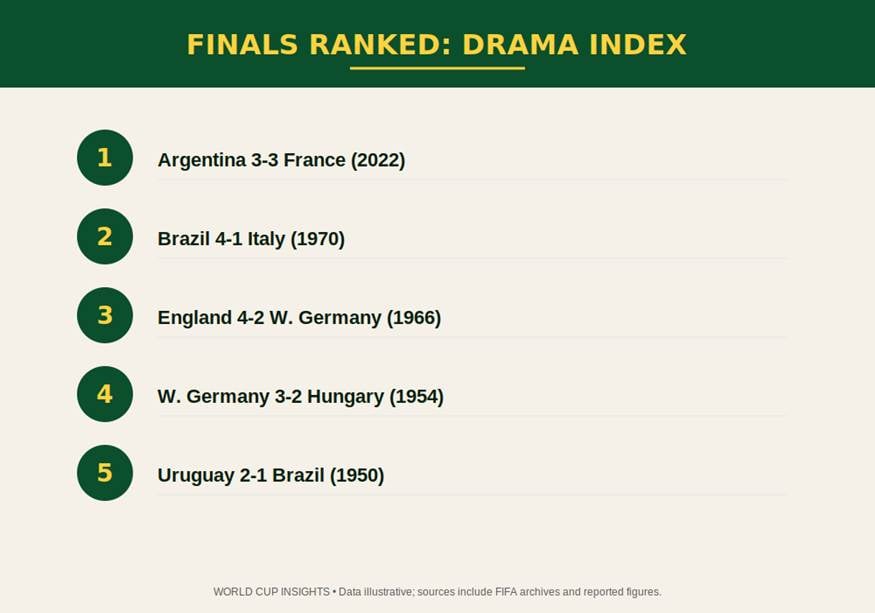
Infographic: Final Ranking: Drama Index Infographic
6. Italy 1-1 France, Berlin, 2006
Decided on penalties, defined by Zinedine Zidane’s header on Marco Materazzi. The closing act of one of football’s best careers ended with a red card. Italy held their nerve from twelve meters. France was heartbroken. The image of Zidane walking past the trophy as he leaves the pitch is the iconography of the World Cup.
7. West Germany 1-0 Argentina, Rome, 1990
Not a classic for purists. Maradona was sent off, two Argentines were sent off and Andreas Brehme scored from the penalty spot. But the symbolism mattered: West Germany’s revenge after the 1986 defeat and the final tournament before reunification. A sad and attractive watch.
Honorable Mentions
Spain 1-0 Holland (2010) was brutal, controversial and historic. He gave Spain his first title. Brazil – Germany 2-0 (2002) it was the finale of Ronaldo’s redemption. Argentina 3-2 West Germany (1986) had Burruchaga’s late winner and Maradona’s coronation. France 3-0 Brazil (1998) brought us Zidane’s double that heralded a new era.
What makes a great finale?
Three ingredients appear again and again on the list. Bets (inheritance on the line of at least one team). Narrative (heroes, villains, redemption). And quality (objectives, technique, dramaturgy). The 2022 final scored highly in all three, which is why it tops the most modern ranking. But ask anyone over 60 and you’ll get a different answer, and that’s precisely what makes the debate so fun.
How the finals have changed
Modern finals reflect modern football: faster, more tactical, more televised, more analyzed. The 1950 “final” in front of 200,000 Maracanã fans was a different cultural moment from the 2022 final seen by 1.5 billion viewers worldwide. Refereeing has evolved with VAR. The replacement rules have been expanded. Overtime has taken on its own tactical subgenre. What hasn’t changed is the weight of the occasion. The way a match can rewrite a player’s legacy, lift a nation or break a heart. The above list spans seven decades, and the common thread in all of them is exactly this emotional dimension.
Where to look back at it all
Most previous matches are available in full on the official FIFA archive, with more details on tournament-specific streaming services. The full 2022 final, in particular, is essential viewing for anyone who questions the quality of modern football. Each replay shows additional details that the live stream could not capture.
conclusion
Every four years, we have the opportunity to add a new entry to this list. With 48 teams and 104 matches scheduled for 2026the odds of a new classic feel quietly high.

