


This should come as no surprise to those who have followed golf participation numbers since the pandemic boom.
According to the National Golf Foundation, there has been a standout 45 percent increase in the number of golfers on the U.S. course as of 2020. Women and girls account for a net gain of 2.5 million, climbing to more than 8.1 million in total, the highest number on record (the previous record was 7.1 million in 2006, before the recession).
Here’s the interesting part: women come into the game at a faster rate than men.
Male golf participation is up just 12 percent for a net gain of 2.3 million players over the same time period.
Wow! Go back and read again – whether it’s total golfers or by percentage, there are more women and girls taking up golf than their male counterparts.
This is despite only 28 percent (a record high) of the golfing population being female.
Let’s take a quick look at why this is happening.
Where does growth come from?
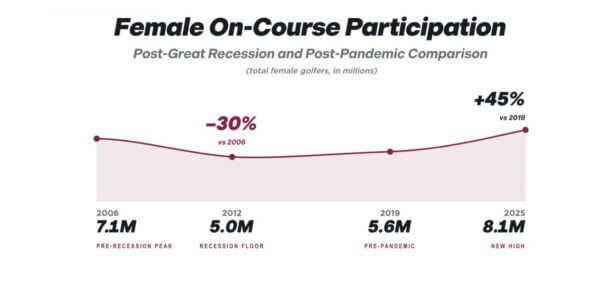
As you’ll see in the chart above, women’s golf participation took a massive hit in the late 2000s and early 2010s. It didn’t pick up at all until this recent big surge.
The NGF points out that the economic downturn of 2008-2009 hit women’s leisure time even more than men.
“More married women entered the U.S. labor force (according to the Bureau of Labor Statistics) as many families sought to make up for lost income, and women absorbed a disproportionately greater share of family responsibilities, whether domestic or child care, during times of economic stress.”
Then came COVID-19. Of course, the impact of the pandemic on the golf industry has been well documented. We need not repeat that discussion here.
But why has the participation of women in golf in particular increased so quickly? Even with the growth helped by the pandemic, the numbers we are seeing are very impressive.
The data is inconclusive on this, but there is anecdotal evidence that golf has become less intimidating.
The barrier to entry is lower and there is less stigma around getting into the game.
An example of this is the off-course golf options that have become more available. Everything from Top Golf to Five Iron to Popstroke is introducing more women and girls to the game in a much less formal setting.
“Women and girls not only make up a higher percentage of young golfers, including beginners and returning players, they also have greater representation among off-the-course-only participants and among non-golfers who are interested in playing on a course,” says the NGF.
Translation: There are even more opportunities for growth in the course.
At these off-course golf options, there are no dress code restrictions. There isn’t a quartet of grumpy old guys waiting in the tee box, urging you to hurry. And some of the other classic obstacles like time, cost and difficulty have been greatly mitigated.
It makes golf seem more accessible. Course play looks more accessible from there.
Before all these off-course options appeared, entering the golf ecosystem was a much bigger leap of faith. Now there are baby steps to get familiar with it.
Women are historically more driven by the social/community aspect of leisure. Golf as a whole has served those community goals since the pandemic because it’s a great value for everyone who gets into the game.
People don’t just want to show up and play – they want to play with like-minded people.
conclusion
Women’s golf is booming and there’s no sign of it stopping anytime soon.
I’m interested to see if the LPGA Tour can benefit from this increase. There seems to be room to run there with developing audiences and rallying around athletes like Nelly Korda.
But on an even larger scale, I think there are more possibilities.
We can build more golf courses where the forwards don’t ask women to take big risks. We can place them to be in the right space at the right angles with the right conditions of the poppy box – not just a marker placed on an uneven road.
We can provide even more of a social/community element to public courses that are used to having a men’s league but not a women’s league.
Hopefully, one day, female participation will exceed 30 percent and go north from there.
I wouldn’t bet against him.

