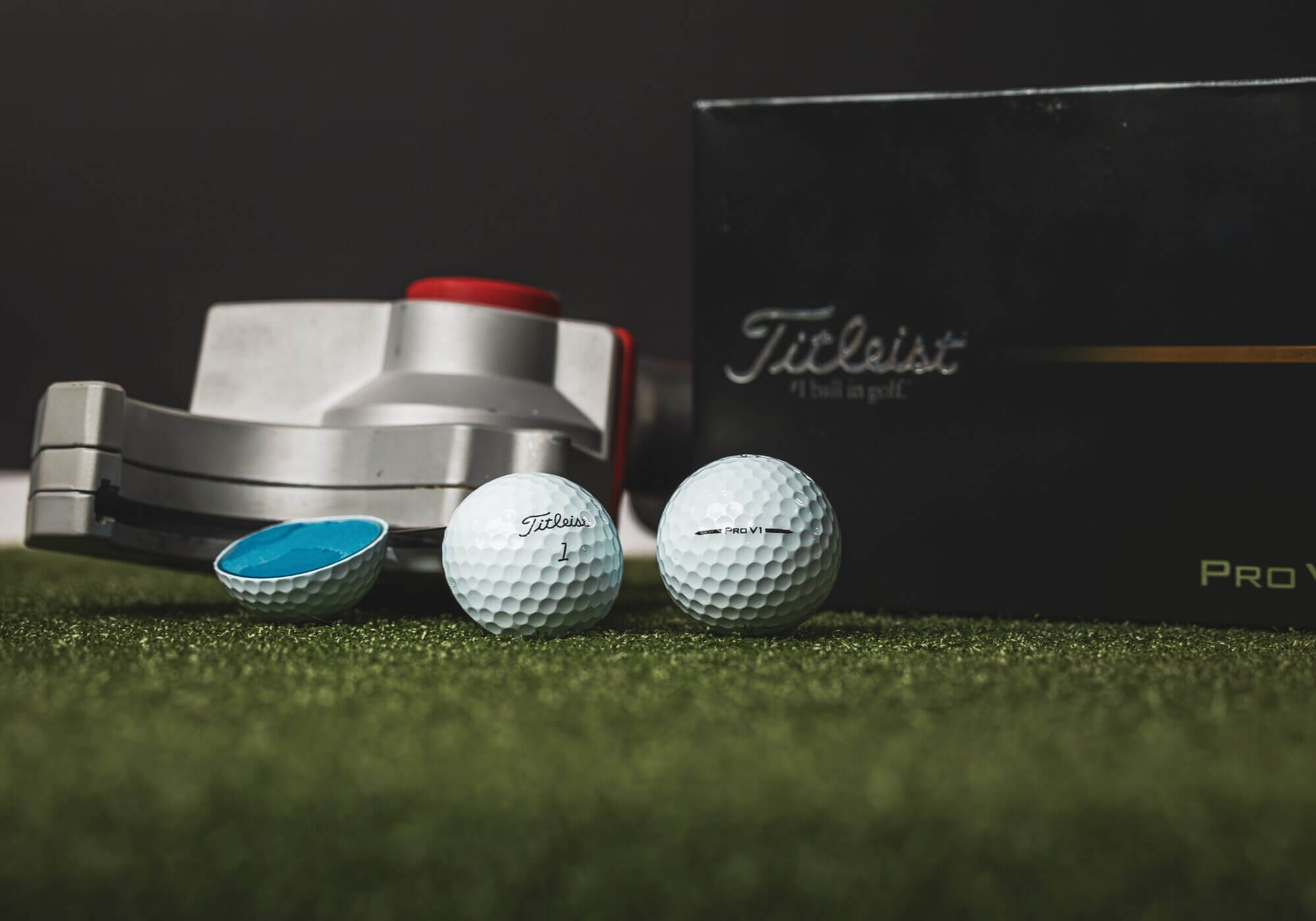
Ball Lab is back. After a hiatus, MyGolfSpy’s production quality testing program is back and we’re kicking things off with the ball that needs no introduction. The Titleist Pro V1 is the golf ball you’ll find in the bags of weekend warriors and touring pros alike, and one that has quietly become the de facto standard against which every other premium ball is measured. If you’re going to restart a test program, you might as well start at the top.
For the uninitiated, Ball Lab does not test how far a ball travels or how it feels around the green. What it measures is the quality of production. The consistency, uniformity and precision with which a ball is constructed. Every ball in the sleeve should work the same way. Each sleeve in a box must be identical. Ball Lab puts this promise to the test with 36 balls in three boxes, measuring weight, diameter, compression, roundness and balance. The result is an objective view of what you’re actually getting when you unwrap a new dozen.
For 2026, we have updated our points system. The new methodology is more punitive on bad balls and weighs consistency of compression more than weight and diameter. In general, scores for higher quality balls will be slightly higher, while poor quality balls will score slightly lower.
Here’s what the Titleist Pro V1 2025 looks like under the microscope.
Titleist Pro V1 (2025)
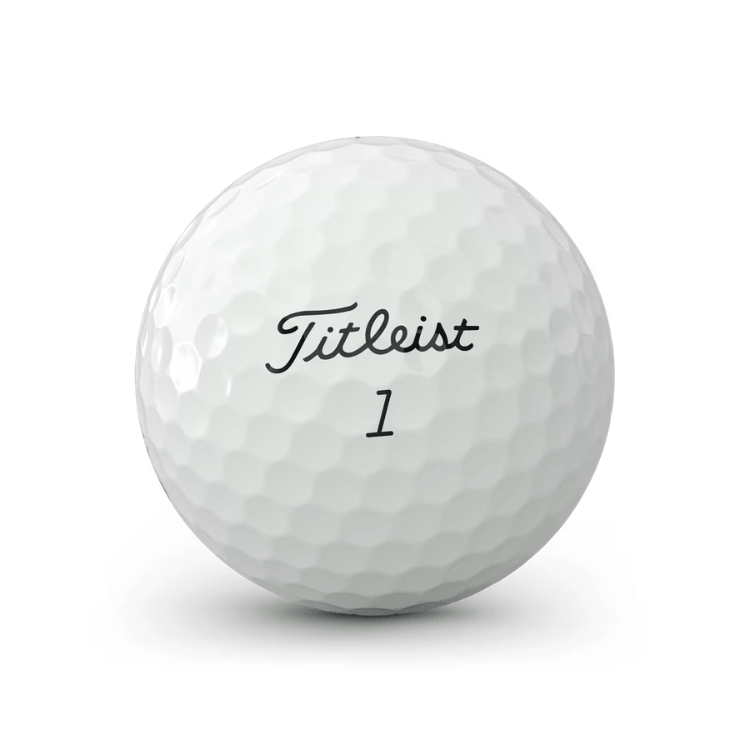
Product details
- Price: $57.99/dozen
- Construction: Urethane 3 pieces
- Compression: 92.5 (Firm)
- Factory: Titleist Ball Plant 3, New Bedford, MA
- Diameter: 1.6805 inches.
- Weight: 1.6091 oz
- Bad balls: 0

How we test
MyGolfSpy Ball Lab was conceived as a tool to evaluate the quality and durability of golf balls. As the saying goes, it’s what’s inside that counts. By shining a light on quality, we can give players better insight into the hidden realities of golf balls on the market today. We hope you will use the Ball Lab as a starting point as you search for your perfect golf ball. For a detailed overview of our testing methodology, click here.
Each Quality Score is a weighted average of five lab grades—defect rate, compression stability, compression symmetry, diameter consistency, and weight consistency—with the heaviest weight on metrics that affect how a ball plays. Defective balls in the box are subtracted from the average, so a sleeve of bad balls is fairly reflected in the final score.
Test results
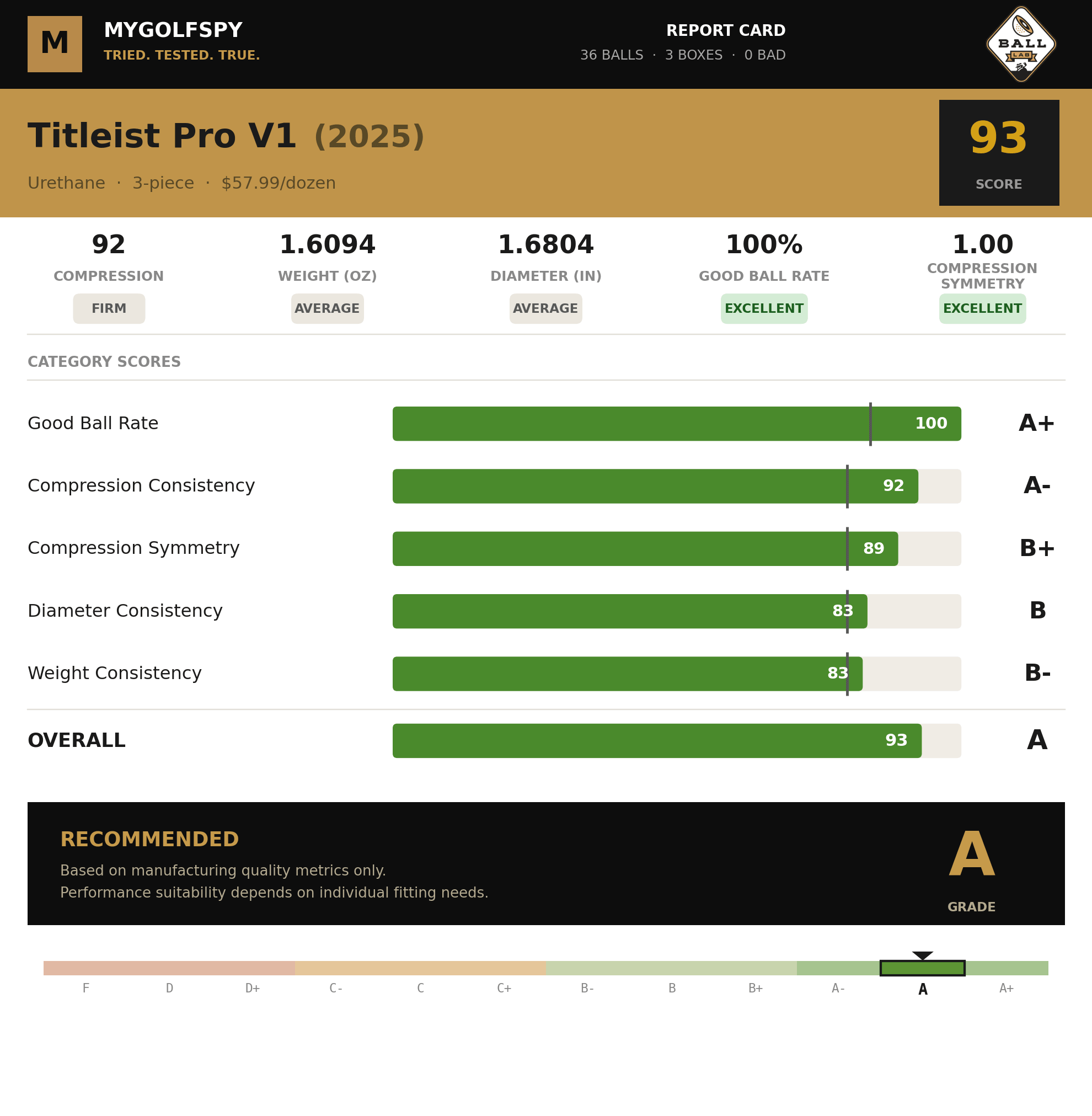
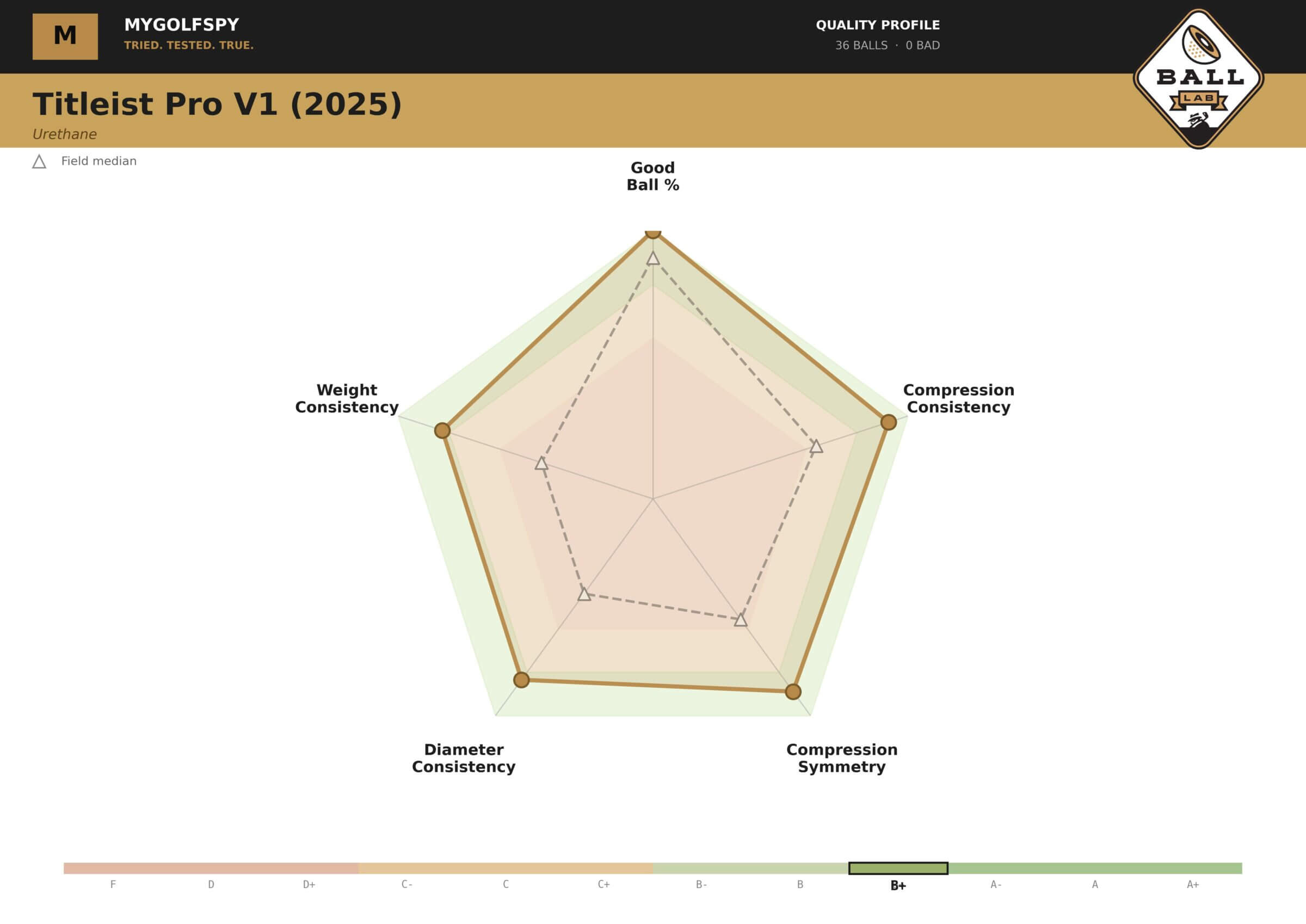
The Titleist Pro V1 2025 scored 93.0 and earned a Ball Lab Quality Award. This score is built on a foundation of exceptional quality control along with consistency metrics that are solid but not outstanding relative to the wider field. Of the categories measured, the good ball rate was 100%. Each of the 36 balls tested passed with zero defects in cores, layers and covers.
Compression consistency earned a good rating, ranking in the top 10 out of 106 balls in the database – well above the field delta average of 9.7 points. A compression delta of 5.3 points means the hardest and softest balls in the sample are nearly identical, which is well above average for the category.
Compression symmetry (previously referred to as IBCR or in-ball compression range) averaged 1.0 points, also well below the field average of 1.9, meaning compression is not only consistent across the sample, but also within any given ball. While you would think this would always be the case, some manufacturing defects manifest as inconsistent compression at the 3 points we measure on each ball.
Where the score pulls is in the consistency of weight and diameter, both of which came out average. It’s rare that a ball stands out for each of them, but these metrics are what kept the Pro V1 from climbing even higher on the leaderboard.
The Pro V1’s quality control is outstanding. A 100% good ball rate and compression consistency that ranks near the top of the database is hard to argue with. With a score of 93, it still easily clears the bar for a quality award.
Compression
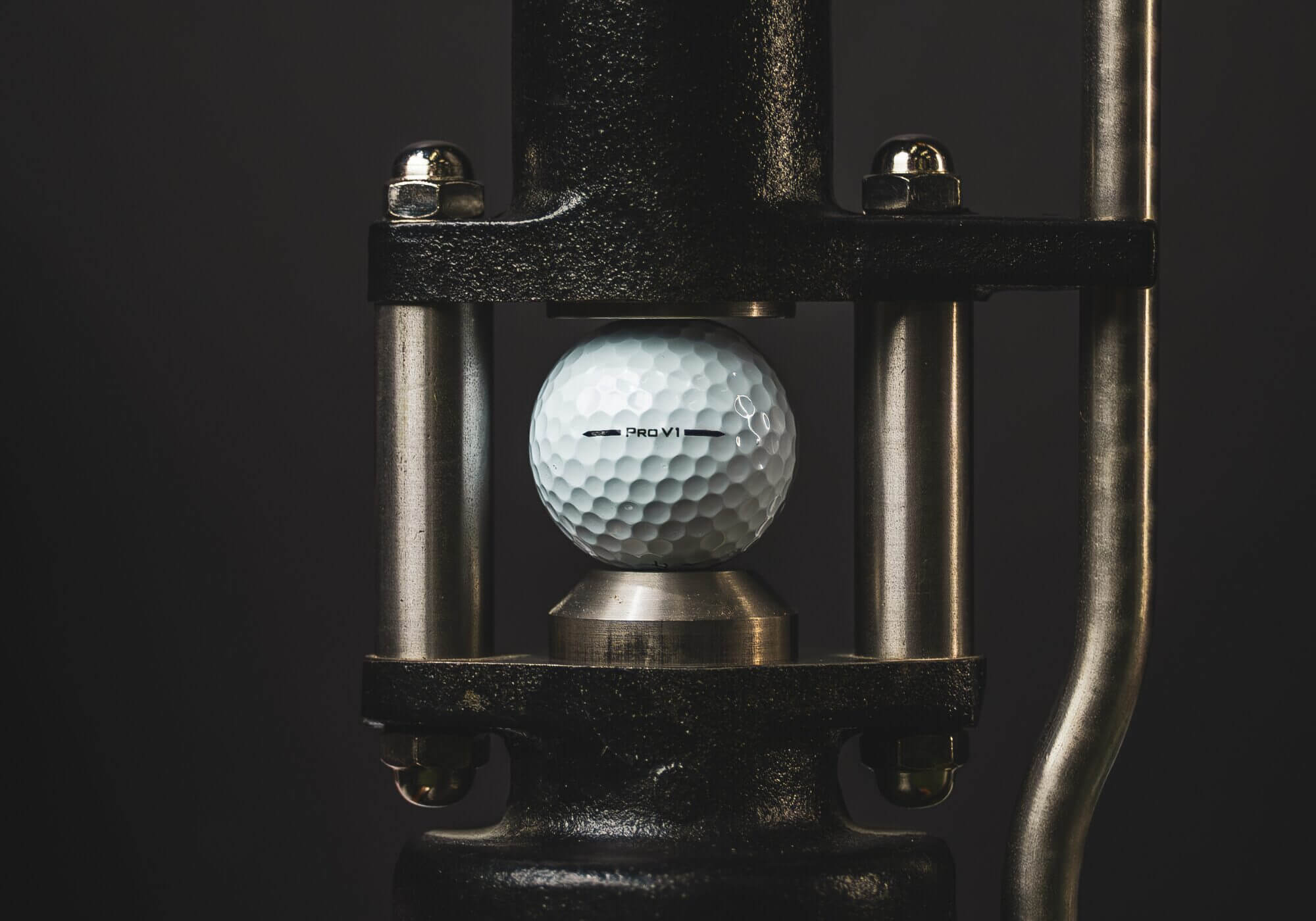
Compression measures how much force is required to deform a golf ball. The more force required, the higher the compression value. Consistency in compression value is important. A ball that compresses differently from shot to shot behaves differently from shot to shot. Ball Lab measures each ball individually and tracks both the mean and the spread across the entire sample.
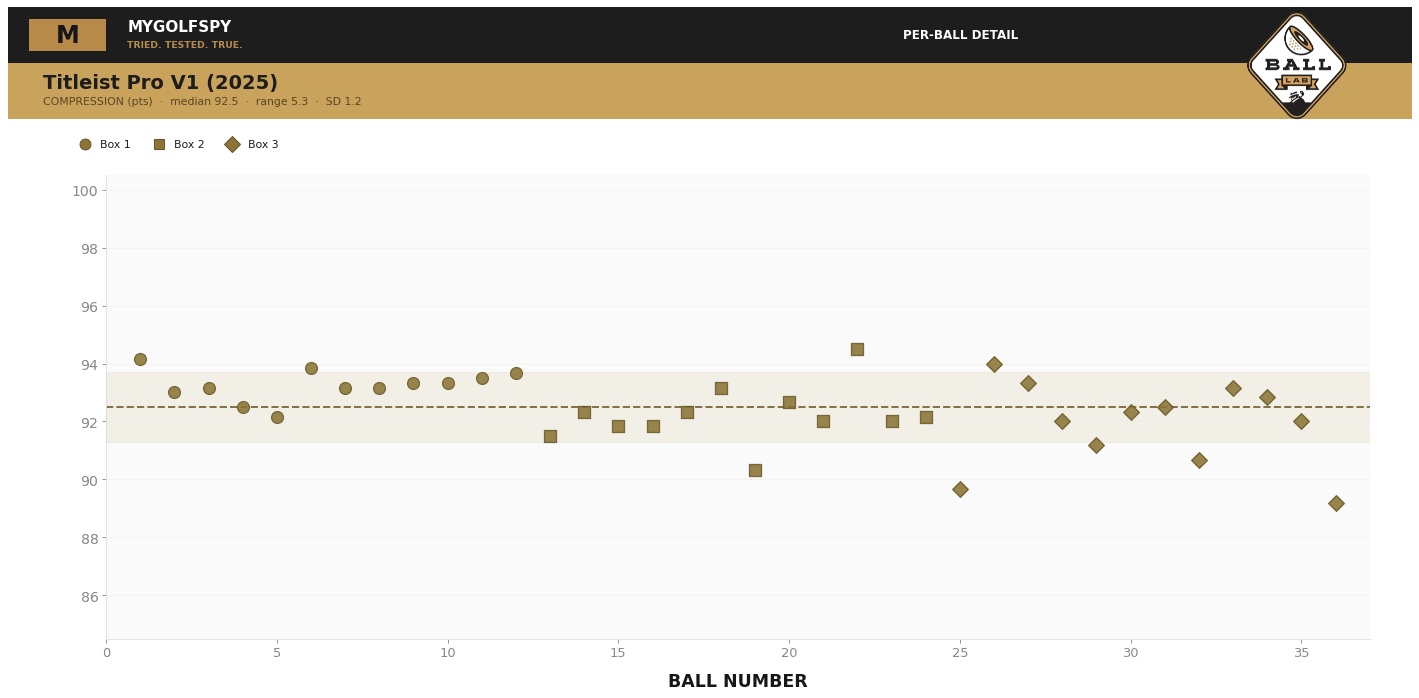
The Pro V1 2025 averaged 92.5, putting it in the strong range of the database. Compression delta – the gap between the highest and lowest reading in the sample – reached 5.3 points, among the best in the database.
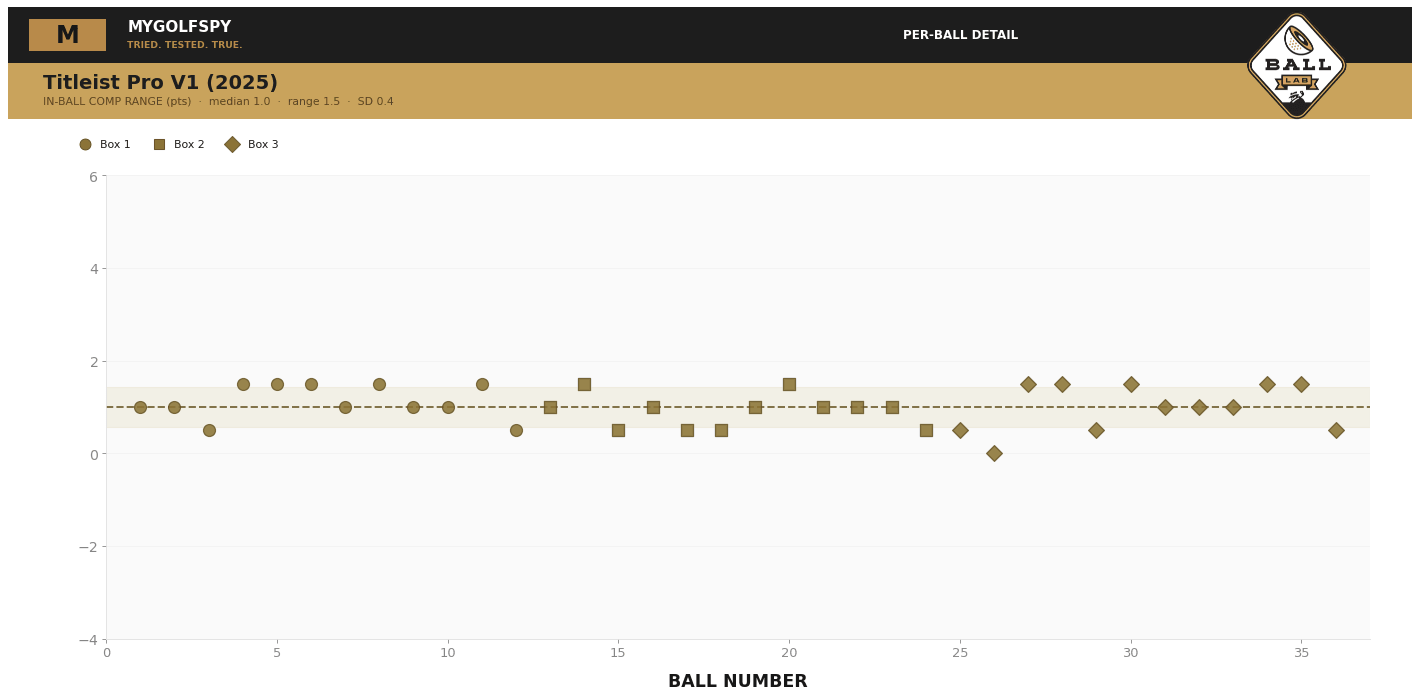
Ball Lab also measures compression symmetry, which tracks how evenly compression is distributed on each individual ball. The Pro V1 averaged 1.0 points of symmetry deviation, well below the field average of 1.9. In simple terms, the value suggests firmness under cover without any indication that the balls are measurably softer or firmer on one side or the other.
The charts below detail the compression measurements on our sample.
Weight
Weight consistency is one of the most underrated quality metrics in golf ball manufacturing. A heavier ball flies differently than a lighter one, so the narrower the weight range in a dozen, the more predictable the ball. Ball Lab weighs each ball to four decimal places.
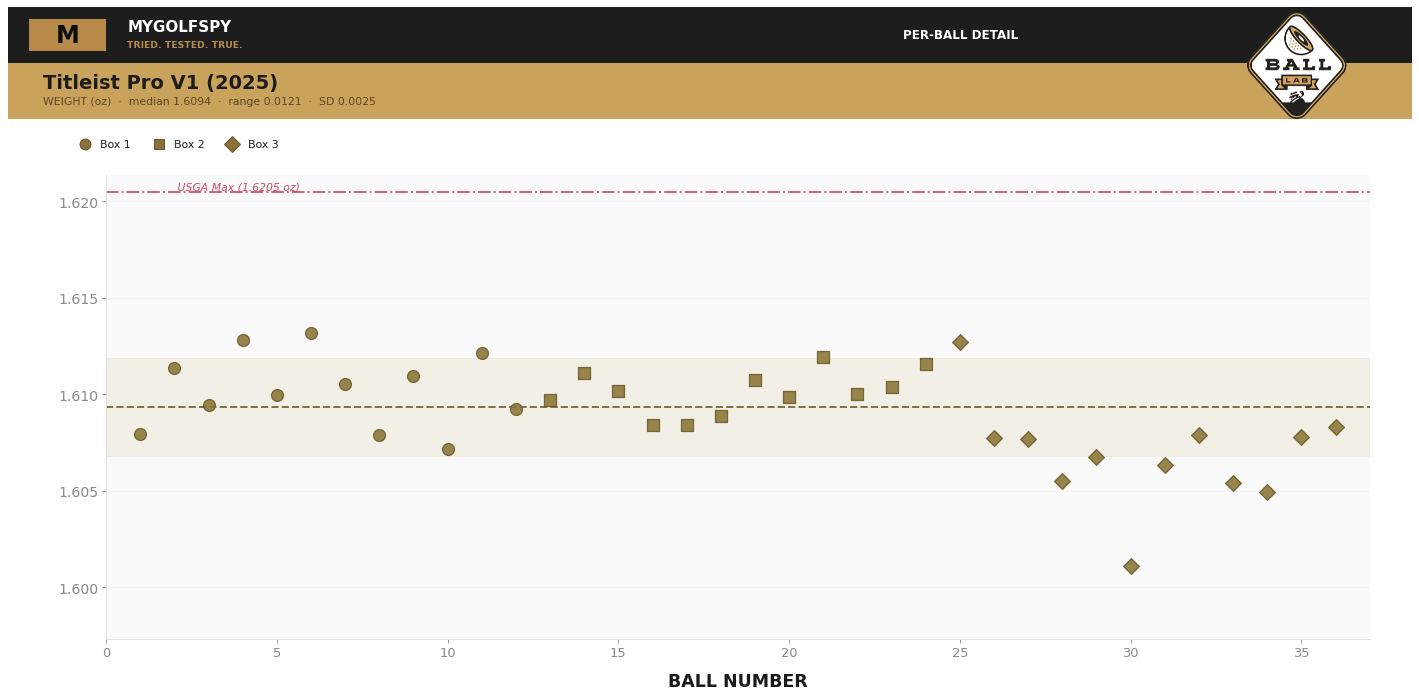
The Pro V1 2025 averaged 1.6091 oz on 36 balls, and every ball in the sample came in under the USGA limit of 1.62 oz. Weight consistency as a category came in average compared to the field and no individual ball was marked as an outside fraction.
The charts below detail the weight measurements in our sample.
Diameter
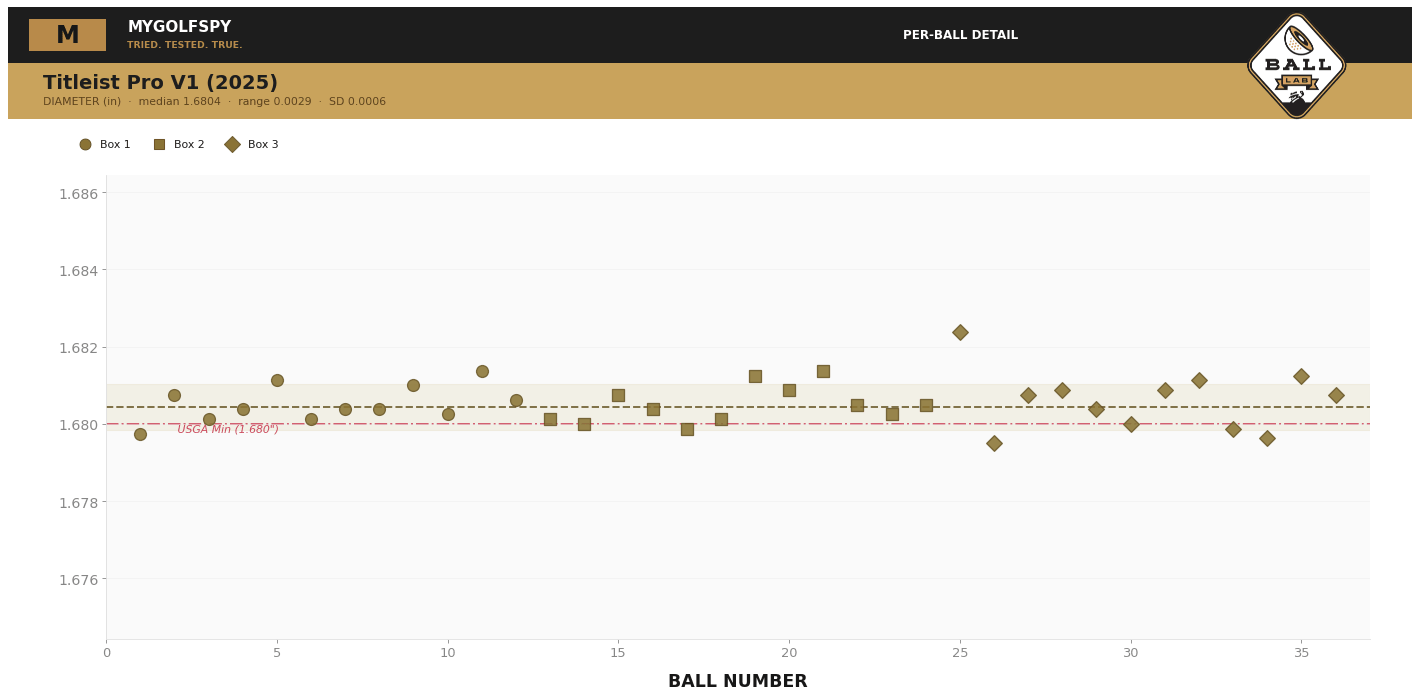
Diameter consistency tells how round and uniform the ball is. An out-of-spec ball can swing off the putter’s face or behave unpredictably in the air. Ball Lab measures each ball across multiple axes to get a true picture of its shape. The Pro V1 2025 averaged 1.6805 inches, above the USGA minimum of 1.68 inches, with a roundness deviation of just 0.0005 inches. Diameter consistency came in average.
The charts below detail the diameter measurements on our sample.
Ball lab report card
Each Quality Score is a weighted average of five lab grades – good ball speed, compression consistency, compression symmetry, diameter consistency and weight consistency. As mentioned, our updated scoring system penalizes defective balls more severely, while giving more weight to compression measurements than weight and diameter.