


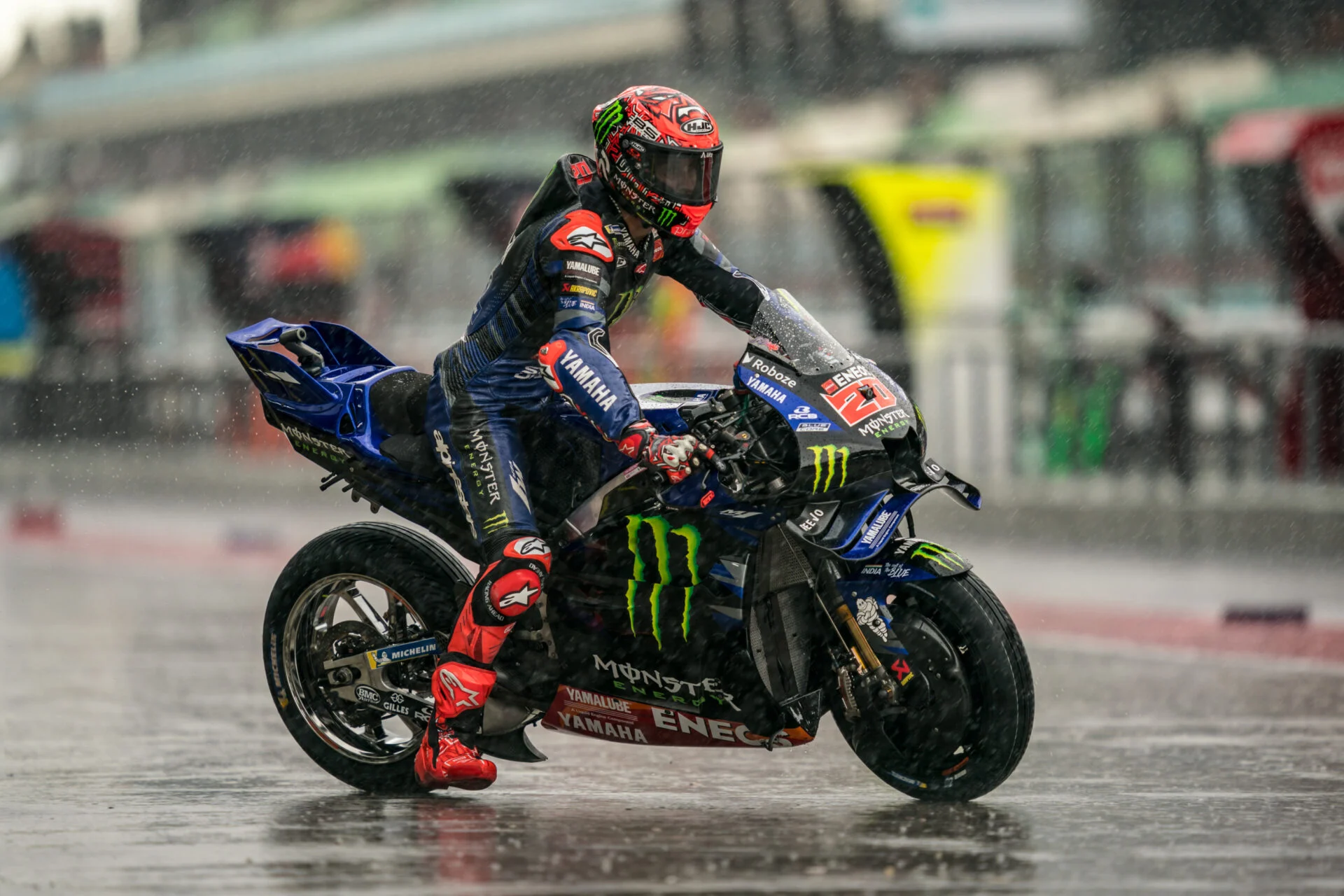

MotoGP has special rules to ensure a safe level of competition in adverse weather conditions. Here’s everything you need to know about the MotoGP wet weather race
The Brazilian Grand Prix is set to host MotoGP for the first time since 1992 this weekend, but the weather forecast could threaten Marc Marquez and the weekend’s racing.
The current forecast indicates a 65% chance of thunderstorms during FP1 and pre-qualifying practice, and the chance of rain drops slightly to 40% for Saturday’s qualifying and sprint race.
The Grand Prix remains in question on Sunday; Although conditions will be partly sunny, there is still a 45% chance of rain which could play a crucial role in the long format race, which will see MotoGP enter flag-to-flag regulations.
What are the MotoGP flag-to-flag rules?
MotoGP uses flag-to-flag rules to ensure race continuity during changing weather conditions. The procedure began when trackside officials waved the white flag, indicating the track was wet enough for equipment changes.
Like Formula 1’s traditional pit stops or World Superbikes involving tire changes, drivers enter the pit lane to change bikes. They physically jump from a machine with fixed tires to a secondary bicycle designed for racing in wet weather.

The decision to switch bikes is left to the discretion of the rider, but safety is paramount: the 60km/h pit speed limit is strictly enforced in racing conditions.
For the 2026 season, officials have doubled the penalties for unsafe exits to prevent collisions in the middle of the spectacular race. If a driver leaves another person’s lane, they will immediately face a Long Term Penalty (LLP) or time penalty.
What happens if a MotoGP race is called wet early?
If rain is falling on a circuit before the start of a MotoGP race, officials will declare the session wet, and the standard flag-to-flag procedure for mid-race transitions is adjusted to prioritize safety.
An extension of the start process has been granted, giving drivers more time for a sighting lap to assess grip levels. Mechanics are allowed to make technical adjustments to the grid.
After the start of the race, it will be classified as a wet race. Unlike a dry race which may be red-flagged for rain, a pre-declared wet race is not stopped for weather unless due to standing water or visibility conditions that are unplayable.
The running distance may also be reduced by one or more laps due to the increased mental and mechanical stress in difficult conditions.
How does setting up a wet MotoGP bike differ from dry setting?
The most significant change involves the stiffness of the prototype’s suspension components. Teams often soften the front forks and rear shock to allow for more weight transfer, giving the rider more mechanical grip under braking, making for a more stable bike.
Brakes will also see a major overhaul. While the bikes use carbon discs in dry racing, wet setups often feature smaller carbon discs with heat shields.
Another noticeable change is the switch from slicks to wet weather tires. These tires feature deep grooves designed to displace standing water and prevent submersion.

The rubber compounds used in rain tires are much softer than dry compounds, which allows them to handle very low temperatures.
But these tires are prone to rapid wear if the track surface is dry, and often drivers find themselves looking for wet surfaces to cool them because they can’t dissipate the heat generated by high-speed friction on dry asphalt.
In addition, the on-board computer has been redesigned. Engineers add traction control and wheelie control by smoothing the engine’s power delivery to prevent rear-wheel spin.
Finally, bicycle geometry is often changed by raising the ride height, which increases the center of gravity to further aid weight transfer during braking and acceleration.
What will happen in Moto2 and Moto3?
There is no flag-to-flag bike swap used in the premier class in the Moto2 and Moto3 classes, as teams in these categories are limited to one rider per motorcycle. Changing track conditions will instead be done through race breaks or mid-race pit stops to change tires.
If heavy rain starts to fall during a dry race, officials wave the red flag to stop the session. This allows teams to bring bikes into the pits to change tires and adjust for wet conditions. The race is restarted as a wet race, usually with a reduced distance.
While technically allowed under flag-to-flag rules, a mid-race pit stop in Moto2 or Moto3 is extremely rare, as mechanics must manually change tires on the rider’s bike.
The time lost is usually unforgivable. In most cases, if the weather changes without a red flag mid-race, drivers simply try to control the conditions on the tires they have.
Receive competition news and updates twice a week to your mailbox

