


For a club of Tottenham Hotspur’s stature, a world-class stadium, a global fan base and a history that demands ambition, two consecutive seasons flirting with the wrong end of the Premier League table is beyond embarrassing. It is a slow financial and structural bleeding. Anyone who checks the The odds of winning the Premier League he won’t find Spurs anywhere near the conversation right now, and for good reason.
After finishing 17th under Ange Postecoglou last season and currently sitting 16ththjust five points above West Ham in the relegation zone with more than ten games to go, the club find themselves in a precarious position that no one expected.
Igor Tudor has been brought in to arrest the slide after the club held on to Thomas Frank for longer than the situation warranted. But changing managers can’t patch up the deeper cracks that are forming.
The talent drain is already happening
When a club’s trajectory stalls, the ripple effects in the transfer market begin almost immediately. Spurs experienced this keenly in the summer and again during the winter window. Eberechi Eze chose Arsenal. Antoine Semenyo opted for Manchester City. Both players were linked with Tottenham and both chose elsewhere, a pattern that speaks volumes for where the club currently stand in the pecking order.
Perhaps most telling were Postecoglou’s recent comments. The Australian confirmed he had specifically wanted proven Premier League quality Pedro Neto, Bryan Mbeumo and Marc Guehi, players who would have significantly improved the squad.
Instead, the club opted for cheaper alternatives. Whether it was a financial decision, a lack of boardroom ambition, or a combination of both, the result was the same: a manager trying to compete with one hand tied behind his back.
The inconvenient truth is that sustained mid-table or lower finishes make this cycle harder to break. The best players have options. They want Champions League football, winning cultures and ambitious clubs. Right now, Tottenham offer neither of those things reliably.
A sponsorship landscape that became much more complicated
Off the pitch, the commercial picture is no less difficult, and the timing could hardly be worse.
Tottenham’s front shirt sponsor AIA has worn the club’s kits since 2013, making it one of the longest-running partnerships in English football. That deal runs out at the end of the season, and while the AIA will continue with the training kit until 2032, it means prime real estate on the front of the game’s jersey is now up for grabs.
Under normal circumstances, this would represent a significant business opportunity. Industry analysis has suggested Spurs’ shirt sponsorship was undervalued by up to £9m a year, meaning the right deal could be closer to £50m a year. But circumstances right now are far from normal, and two factors conspire to significantly complicate this picture.
The first is the Premier League’s incoming ban on gambling advertising on the front of shirts, which will come into effect at the end of this season. Historically, gaming companies have been among the biggest spenders on jersey sponsorships, often paying well above market value for visibility. Take them off the market and reduce the pool of potential buyers and probably squeeze the price ceiling.
The second is the form. Business partners are buying a brand, a story and a partnership. Finishing 16th and 17th in back-to-back seasons is not the narrative a premium sponsor wants to join. At a time when Tottenham should be the most attractive to potential partners, they may be the least attractive.
The naming rights saga continues
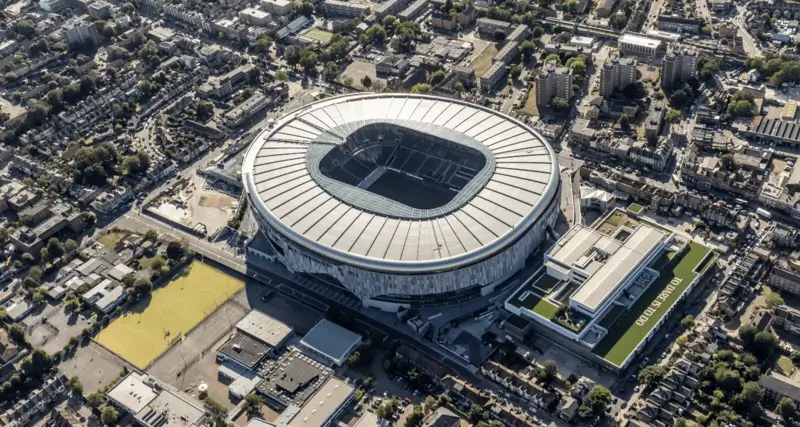
Then there is the stadium itself. Tottenham Hotspur Stadium is by any measure one of the best venues in world football. The £1 billion facility has hosted NFL matches, major boxing bouts, Beyoncé residencies and Formula 1 karting. It’s a true all-round entertainment venue. And yet, six years after opening, it still doesn’t have a naming rights partner.
Compare that to Arsenal’s Emirates Stadium or Manchester City’s Etihad Stadium, deals that have generated hundreds of millions of pounds and given both clubs a significant financial advantage. Tottenham, meanwhile, have lost an estimated £75m in revenue in the years without a deal, according to figures reported by Football Insider. With a target price of around £20m per season, the cost of the delay is substantial.
The club’s position has been that having “Tottenham Hotspur Stadium” above the gate serves the brand well, that association with the NFL, global artists and elite sporting events provides free exposure that a naming rights partner could complicate. And there is something to this argument. But it’s also the kind of reasoning that sounds a lot more compelling when the football team is doing well.
Now progress is being made. A new commercial director with expertise in naming rights has been appointed, and the club is understood to be exploring a segmented approach, similar to the MetLife Stadium model, where different partners share different parts of the deal. It remains to be seen whether they can secure such a deal in the near future, but the longer it drags on, the more the gap with their rivals grows.
The problem of composition
What makes all of this really troubling is that these problems don’t exist in isolation. They feed each other. Mediocre league finishes make it harder to sign top players. Signing inferior players makes it more difficult to improve the position in the league. A declining product on the pitch makes shirt sponsors less enthusiastic and naming rights negotiations more difficult. Less commercial income means less money to invest in staff. And so, the cycle continues.
Those who are guarded soccer predictions for Spurs this season will know that the club is unlikely to be relegated. Tudor’s appointment has at least steadied the ship in that regard. But avoiding the drop is a very low bar for a club that was genuinely in contention for the title not so long ago, and the medium-term risks are real.
Tottenham have the infrastructure of a top four club. The stadium, the fan base, the global brand, it’s all there. But infrastructure without performance is just expensive scaffolding. Until results on the pitch improve consistently and sustainably, the price of this prolonged mediocrity will continue to rise, commercially, competitively and culturally.
The bill is being drafted. The Spurs need to start paying him before he becomes unmanageable.

