


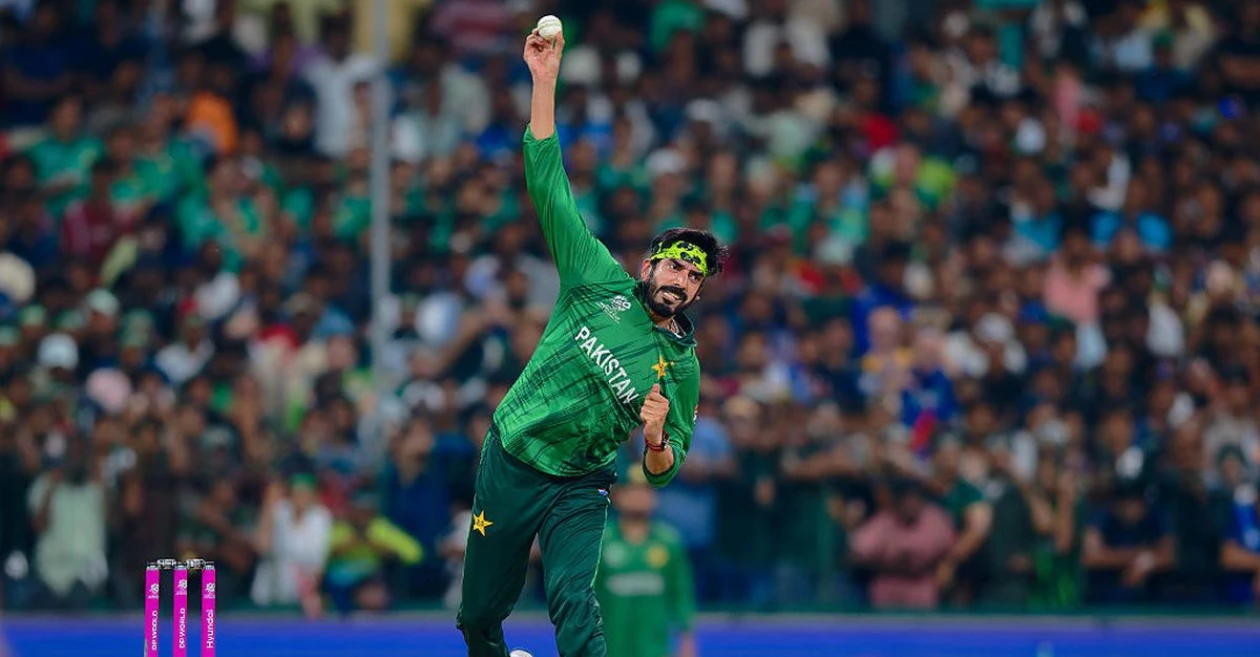

Pakistan is spinning Osman Tariq The ICC Men’s T20 World Cup 2026 clash with the United States of America (USA) has once again found itself at the center of the ‘illegal action’ debate. However, the controversy has not overshadowed his impact with the ball.
Tariq delivered a match-defining performance, conceding three crucial wickets – Milind Kumar, Harmeet Singh and Mohammad Mohsin – for just 27 runs in four overs. His disciplined off-spin proved decisive Pakistan successfully defended a total of 190 menSealing a 32-run win.
With the pressure mounting in the middle innings, Tariq’s spell halted the US chase and swung the momentum firmly in Pakistan’s favour.
Controversy over Usman Tariq’s bowling action
Despite his imposing figure, attention quickly shifted to Tariq’s unorthodox bowling style. The spinner had previously been reported twice in the Pakistan Super League (PSL), though he was cleared both times after being tested.
Ahead of the T20 World Cup, during Pakistan’s home series against Australia, Australian all-rounder Cameron Greene was seen furiously imitating Tariq’s move after being dismissed by Tariq. Green later apologized after reviewing replays and admitted his reaction was wrong.
Tariq has consistently argued that his actions were in accordance with ICC rules, offering medical and technical explanations to clear up doubts.
Medical explanation behind Tariq’s action
In medical terms, Tariq is said to have clubbed elbows that prevent him from fully straightening his arm. This anatomical feature gives his bowling action a unique look and often leads to misinterpretation.
There have been similar cases in the history of cricket. Sri Lankan legend Muttiah Muralitharan had a congenital deformity that limited the straightening of his bowling arm and caused controversy for years before it was cleared up.
The introduction of the 15-degree bend rule, implemented under former ICC president Jagmohan Dalmiya, provided clearer guidelines and allowed bowlers with natural hyperextension to continue with impunity as long as they stayed within the permissible limits.
Tariq’s bowling action consists of a short, zigzag run and a short pause before the delivery. While the break and sidearm release may seem unusual, they are consistent across all deliveries. Critics argue that such variations can give the bowler an advantage by disrupting the batting rhythm.
However, under ICC rules, consistency and arm’s length, not aesthetics, are the main factors that determine legality.
Also READ: Mayanti Langer, Laura McGoldrick to Grace Hayden: Complete List of Hosts for T20 World Cup 2026
Justice Anil Chaudhary’s take on Tariq’s action
In the light of renewed research, the respected Indian judge Anil Chaudhary offered a clear and decisive opinion. After watching the footage of Tariq’s bowling, Chaudhary said the action was completely legal.
He explained that although Tariq was slightly bent to the side and the pause was included, there was no visible bending or straightening of the arm beyond the permissible limit. Crucially, he emphasized that the spinner delivers every ball in the same way, fulfilling the requirement of consistency.
“I think his move is fair and it’s a fair delivery” Chaudhary said, stressing that unusual does not automatically mean illegal.

