


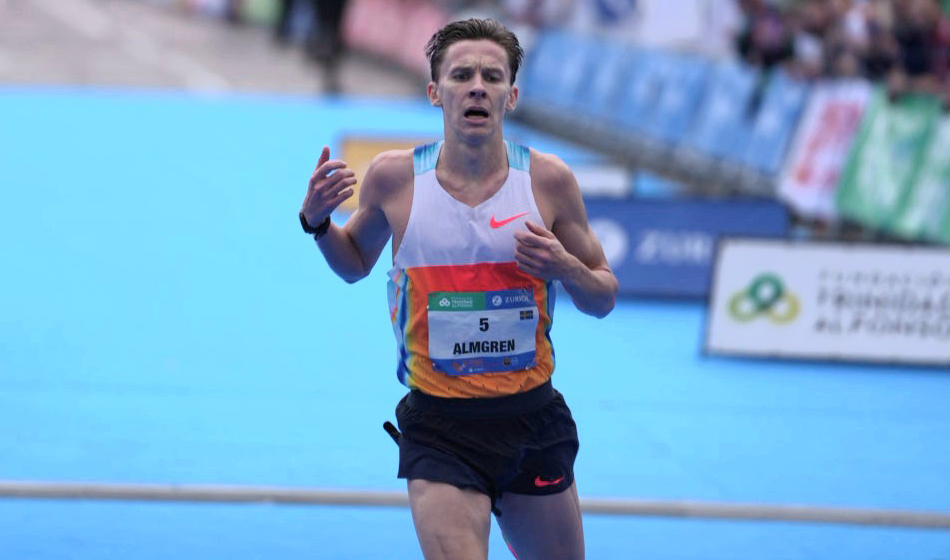
The European 10km record holder talks climbing the world, making history, training with Jakob Ingebrigtsen and targeting Birmingham gold.
Andreas Almgren feels like he’s just getting started. “If I can do a perfect race with good racers, there’s a lot more in my body to go faster,” he says. It’s less than a month since the Swede smashed his own European 10km record by eight seconds, running 26:45 to win in Valencia and move up to sixth on the all-time list. It was his fourth competitive road race at the distance.
Now the 30-year-old has swapped the flat and fast tarmac of Valencia for the mountainous terrain of the Sierra Nevada, a high-altitude training base at 2,320m/7,611ft above sea level in the Andalusian province of Granada.
His plan is to stay there for a few more weeks before heading to Castello on February 22 for a race over 10km. Yomif Kejelcha ran 26:31 to win last year’s race, which would have put the Ethiopian second on the all-time list, and Almgren sees the race as an opportunity for Valsia to go even faster.
“The speedometer only picked up three or four kilometers, so that was a bit of a disappointment,” he tells AW. “I had to run six kilometers by myself. The conditions were really good, though.”
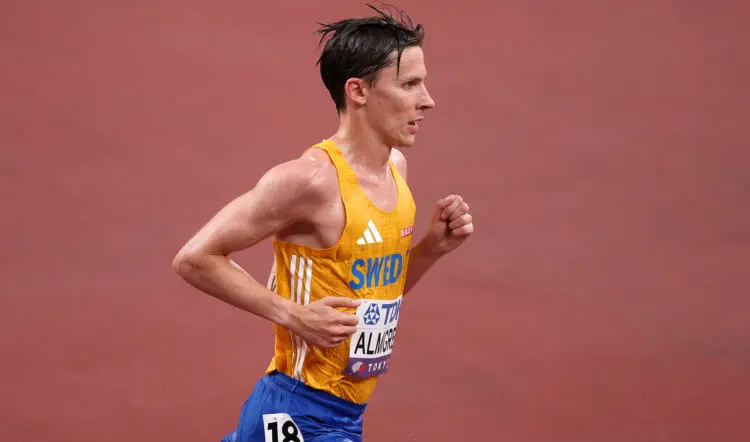
His final training session before the race was a 10x1km interval session, clocking 25:37, four seconds faster than the 30-year-old’s time in the same session last year.
“Using bike speed on a closed track is a bit of a cheat code,” jokes Almgren. “So I was confident that I could improve my record. It’s only been two years since my first 10km race (27:38 in Valencia) so right now I feel like I harvesting the seeds I planted a few years ago. For any endurance sport, you just need time to develop. It’s only natural that I’m improving now.
“It’s hard to say if I can beat the world record (Ronex Kipruto’s 26:24 in 2020) because I still have to shave off more than 20 seconds. I think I can run 26:30 soon. Hopefully I’ll have a good shot at running Castello.”
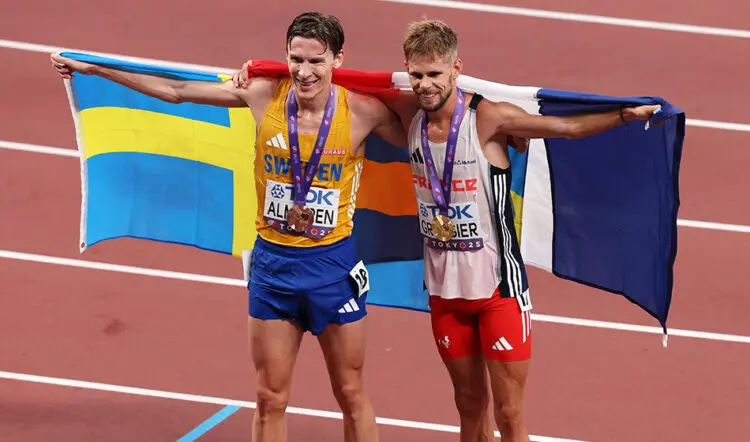
Last year, Almgren proved his versatility in several distances, setting European records in the 5000m (12:44.27) and half marathon (58:41), as well as national marks in the 3000m, 5km and 10,000m. Perhaps most memorably, however, he secured the first senior world medal of his career at the Tokyo World Championships, losing bronze to Jimmy Gresier and Kejelcha. It was the first time since 1987 that two European athletes had topped the world 10,000m podium.
“I’ve finally reached the level I want to be,” he says. “In 2024, I felt a bit of an outsider. Now I feel like I’m one of the top guys and I have the confidence to just go to the front of the race and control it.
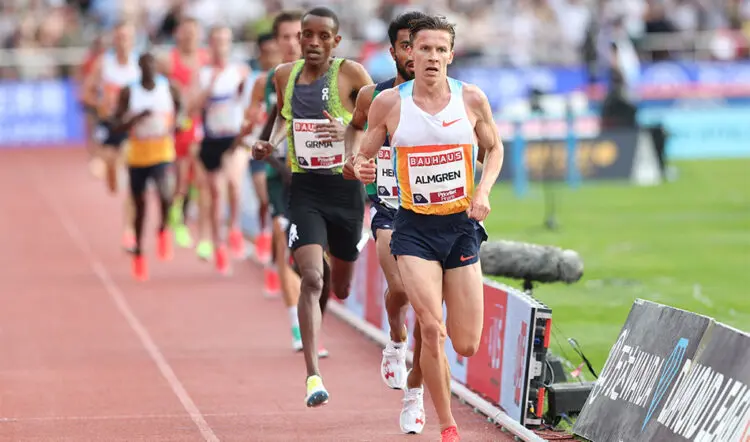
“I prepared for the Olympics with a ‘sit and kick’ tactic, but missed the games with a stress fracture. Then I trained again in October 2024 and since then I have hardly had any breaks in my training. My form now is just proof of what can happen when you finally get some consistency.
“I did some serious warm-up training before the Tokyo Championships. I knew the humidity would be high. I also worked a lot over the summer on my swing and change of pace, which I hadn’t done in previous years.”
Almgren is coached by Urban Arun, who was voted as just last month The best coach of the year in Swedish athletics gala. The pair have been working together since 2012 and their relationship has grown steadily over the past 14 years.
Almgren competed in the 800m and won a bronze medal at the 2014 European Junior Championships in 1:45.65, a time that still stands as the Swedish under-20 record. He lowered his two-lap PB to 1:45.59 in 2015, but then suffered multiple injuries over the years.
In 2019, while on an exercise bike as part of her recovery from a cervical stress fracture, she watched compatriot Kalle Berglund reach the world 1500m final in Doha. That moment was a turning point. After returning from injury, Almgren added two double hurdles to her training week, the Norwegian method that inspired Berglund, and to test her new training schedule, competed in the 3,000m at the 2020 Swedish Indoor Championships.
Not only did Almgren break the Swedish 3000m indoor record of 7:48.34, but she beat Berglund by almost 10 seconds. He has since prioritized longer distances and never looked back.

“The kind of training I’m doing now means I can basically build a base from the 1500m to the half marathon,” says Almgren. “Urban was like a ‘pure trainer’ when I was younger, but now it’s more of a two-way street where we discuss core training. So I usually write the program and then ask him what he thinks about it. He makes me ask questions. For example, he will say: “Are you sure you need to do this last interval?”
When asked about his current training at Sierra Nevada, Almgren says: “I usually run about 200 km a week. On Mondays and Wednesdays, I do two easy runs and a few steps, which is a pre-workout. I do double thresholds on Tuesdays and Thursdays.
“Friday is the easiest day, with one easy run of about 10-12km, and there is strength work as well. I have my hardest workout on Saturday and it’s a mix of hill work and half marathon training. Then, in the afternoon, it’s an easy run. Sunday is a long run, about 25-30 hours.
“For my easy runs, I always go by feel. So if I’m feeling tired I’ll go slower and then if I’m feeling good I can run them pretty fast. On my long runs I can average between 3:30 and 4:10/km.
Training inspiration is not lacking either. Almgren has spent a lot of time with Jakob Ingebrigtsen and being close to the Norwegian during the sessions is invaluable.
“Training with Jacob is definitely motivating,” she says. “We ran together a lot last winter and he was insanely strong. Everyone saw that when he set the world indoor 1500m (3:29.63) and mile (3:49.15) records in Liewyn. He was so impressive then, winning double gold at the European and World Indoor Championships.
“We’ve discussed training quite a bit, but it’s more the general philosophy than anything specific like gym routines or nutrition. He was very open with me about what he believed. I think he also appreciates training with me because we are pretty similar in thresholds.
“More so when you get to the faster, more specific workouts, he’s on a different level. I have been humbled by him in many of them. He can only run so fast without feeling the effects of lactate. I’m quite jealous of that.”
So what areas of training does Almgren believe he can improve on? “Everywhere,” he laughs. “Obviously, I can be faster in the sit stroke, but I also see myself getting stronger in those ‘light’ sections of training, so not when you’re going full throttle and not when you’re doing thresholds.
“I’m still learning new things when it comes to thresholds and I also want my body to handle lactate much better in the future. I haven’t really raced that long distances. I have only run two half marathons (eg Barcelona 2024 and Valencia 2025). my body.”
Almgren will train in the Sierra Nevada in the spring before switching to St. Moritz as a base in the summer months. His main aim is to secure the European 10,000m gold in Birmingham this year.
“I haven’t stood on top of the podium at a major championship yet,” he says. “I also want to improve on my 5000m of 12:44.27 and set a 12:3 mark this season (Joshua Cheptegei’s world record of 12:35.36 stands from 2020).
He is undecided whether to compete in the 5,000m at the inaugural World Championships in Budapest or the half marathon at the World Athletics Road Championships in Copenhagen. Only six days separate the September events.
“The main thing for me this season, above all else, is to stay injury-free,” adds Almgren. “I’ve suffered from them all these years and it stays with you. I feel like I’m in a much better place in my career now, so the future will be very interesting.”

