


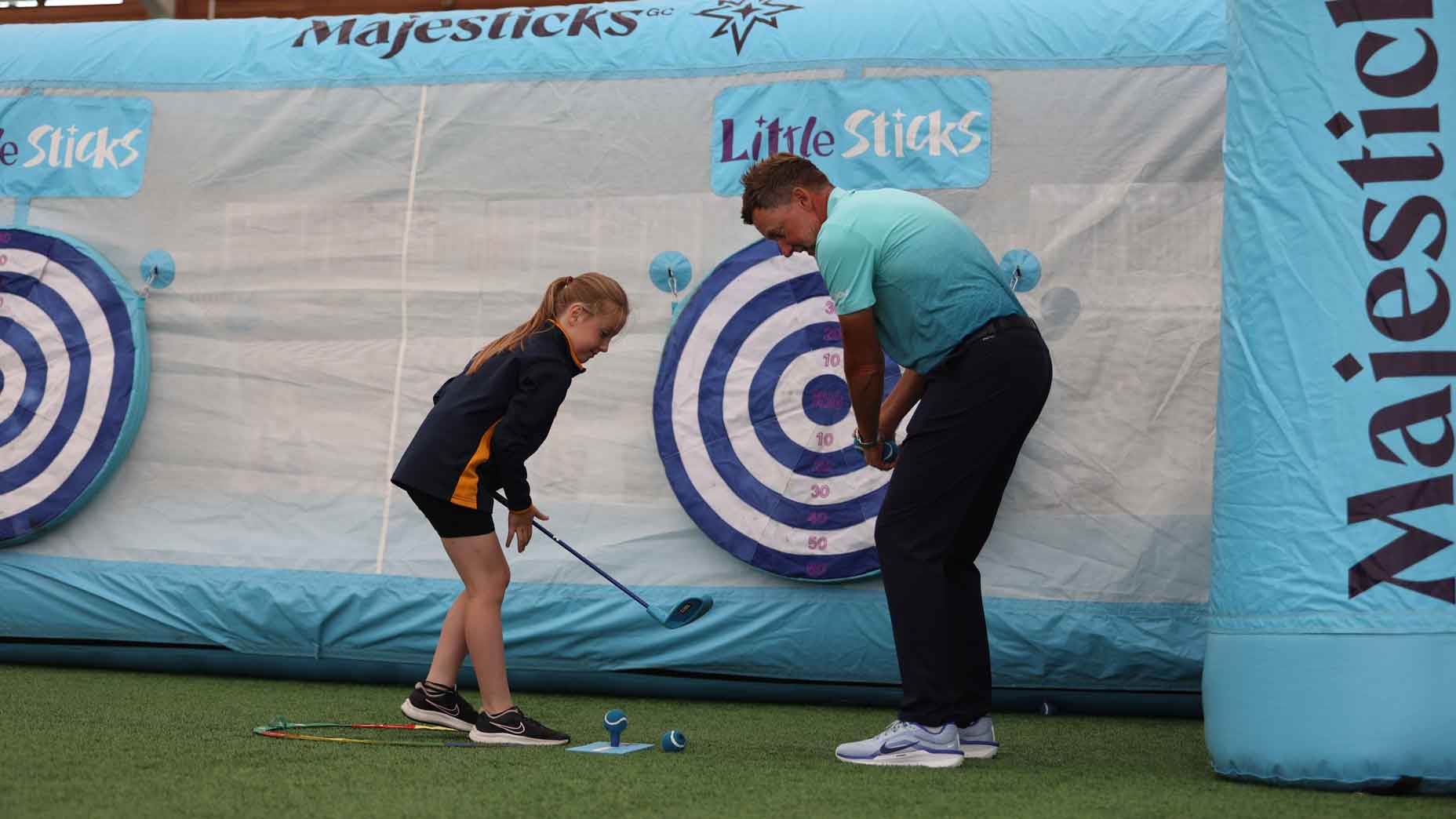
Lee Westwood and Ian Poulter have been teammates for decades, first in Europe Ryder Cup team and now as members of LIV Golf’s Majesticks GC.
Through the latest association, Westwood and Poulter have now collaborated on another initiative: a community impact program with children in charge.
Together with team co-directors Oliver Banks and James Dunkley – and Jordan Stephenson, who joined the organization from Youth Trust Sport in the UK and serves as Majesticks’ head of impact and culture – the team created Little Sticks, a first-of-its-kind curriculum designed to foster a more inclusive and enjoyable environment for children and young people to help them. The main goal of Little Sticks is to educate, engage and empower young people by introducing them to the game and its values.
“Community has always been at the heart of what we’re trying to do,” Banks told me recently. “A lot of golf programs have come in and not done particularly well, so there’s an opportunity for us where we can make a difference.”
;)
Courtesy of Majesticks GC
The Little Sticks pilot program began last year with programming for elementary and middle-aged children in six schools in the UK and one in the US. According to Stephenson, one of the program’s biggest challenges was convincing physical education curriculum administrators that golf was a worthy inclusion. Once they decided to implement the program, Stephenson facilitated the distribution of the necessary equipment, training and resources. The pilot was a success, Stephenson said, with data showing that nearly 60 percent of children had a significant positive change in their well-being after attending at least six sessions of Little Sticks.
Little Sticks isn’t just about learning the game of golf. The 12-week program takes a comprehensive approach, providing the fundamentals in the form of 15 simple games, while also emphasizing mental and physical well-being. Curriculum includes offering Poulter and Westwood instruction and encouragement in video form, with players representing character values such as resilience (Westwood) and teamwork (Poulter).
“We’re giving them skills and tools that can help their future, but also giving them a sense of belonging,” Stephenson said. “They belong to our team, the Majesticks, they belong to our players, so they also have a wider sense of community. What we really want to do is use our players as role models, so we have tangible people that our kids can learn about and teachers can use in their lessons.”
The Little Sticks curriculum also reinforces these character-building lessons within the games children play rather than just in a presentation-style classroom setting, making it fun and engaging.
;)
Courtesy of Majesticks GC
“If you’ve observed a PE lesson, 95 percent of the time, kids are playing golf, just the activities they’re engaging in are designed to help bring out those character-building skills,” Stephenson said. So it’s not, ‘Everyone sit down, we’re going to show you about sustainability.’ Instead, it’s ‘You’ve played this game, how did you find it? Did you find it challenging? What have you done to overcome if you thought you couldn’t? How did you use other people for support?’”

